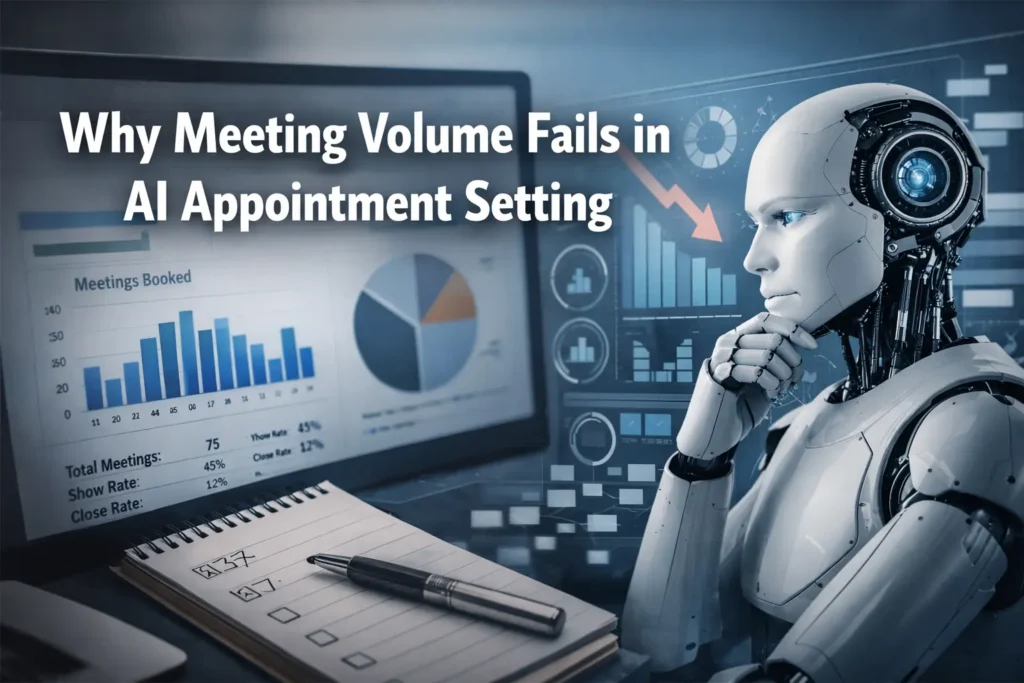
For decades, outbound sales teams have measured success by one simple number: how many meetings were booked.
As AI appointment setting becomes more common, many teams have carried this metric forward without questioning it. The result is a familiar pattern—full calendars, exhausted sales reps, and pipelines clogged with low-intent conversations.
The problem is not AI. The problem is the metric.
Once appointment setting is understood as a decision system, not a scheduling task, it becomes clear that meeting volume is the wrong measure of success.
The Legacy Assumption: More Meetings = Better Performance
Traditional SDR teams are evaluated on activity:
- Calls made
- Emails sent
- Meetings booked
This made sense when human labor was the constraint. If SDRs booked more meetings, leadership assumed more opportunities would follow.
AI changes that equation.
- AI does not get tired.
- AI does not avoid rejection.
- AI does not need to “stay busy.”
So when AI is judged by meeting volume, it will optimize for the easiest possible outcome: booking more meetings, regardless of quality.
Why AI Exposes Broken Metrics Faster Than Humans
Human sales reps subconsciously filter:
- Weak interest
- Unclear authority
- Vague objections
They do this to protect their time and energy.
AI does not have that instinct unless it is explicitly designed into the system.
When meeting volume becomes the primary KPI:
- Low-intent prospects are treated as wins
- Polite deflections become “success”
- Calendars fill, but pipelines do not
AI doesn’t create this problem—it simply reveals it at scale.
Appointment Setting Is an Outcome, Not the Objective
As explained in AI Appointment Setting Guides: How AI Decides When to Book Meetings, scheduling should be the result of good qualification and intent detection.
When teams reverse that logic and treat booking as the goal:
- Qualification becomes superficial
- Objections are ignored
- Uncertainty is overridden
This leads to:
- Low show rates
- Unproductive discovery calls
- Declining rep trust in AI systems
The calendar looks healthy. The revenue does not.
The Cost of Low-Quality Meetings (That Metrics Hide)
Every unnecessary meeting has a real cost:
- Sales time wasted
- Opportunity cost for better prospects
- Rep burnout
- Longer sales cycles
These costs rarely appear in dashboards because they are downstream effects. Meeting volume metrics capture the start of the process, not the outcome.
AI appointment setting forces teams to confront this mismatch.
The Better Question: When Should AI Exit Instead of Booking?
One of AI’s greatest advantages is its ability to exit consistently.
High-performing AI systems are designed to walk away when:
- Intent is ambiguous
- Objections remain unresolved
- Authority is unclear
- Timing is wrong
This behavior looks like failure if success is defined as “meetings booked.”
In reality, it is a sign of mature decision logic. An AI system that exits frequently is often protecting sales capacity better than one that schedules aggressively.
Why Exit Rate Is a Health Signal, Not a Problem
In AI-driven outbound systems:
- A higher exit rate can indicate better qualification
- Fewer meetings can produce better outcomes
- Silence can be preferable to noise
This reframes success away from activity and toward signal quality, a core idea in modern AI sales strategy.
AI does not need to justify its existence by staying busy. It needs to justify its decisions by improving outcomes.
What AI Appointment Setting Should Be Measured On
Instead of meeting volume, AI appointment setting performance should be evaluated on:
- Downstream conversion quality
- Meeting relevance to ICP
- Reduction in low-intent conversations
- Sales team confidence in scheduled meetings
These metrics are harder to measure—but they reflect reality.
Why This Shift Feels Uncomfortable (And Necessary)
Meeting volume is easy to understand. Quality is not.
Shifting away from booking-based KPIs requires:
- Trust in decision systems
- Patience in evaluation
- Alignment between sales and strategy
AI forces this shift sooner than most teams expect. Those who adapt gain leverage. Those who don’t drown in activity.
Key Takeaways
Booking more meetings is not evidence that AI appointment setting is working. It is often evidence that the wrong metric is being optimized. AI performs best when allowed to exit low-intent conversations, protect sales time, and prioritize signal over volume. Meeting quality—not meeting count—is the metric that aligns AI decision-making with real revenue outcomes.
FAQs
Why is meeting volume a bad metric for AI appointment setting?
Because it rewards scheduling behavior without accounting for intent quality or downstream outcomes.
Should AI ever prioritize booking fewer meetings?
Yes. Fewer, higher-quality meetings often lead to better conversion rates and healthier pipelines.
What should replace meeting volume as a KPI?
Metrics tied to qualification accuracy, conversion quality, and sales team trust.
Does exiting conversations mean AI is underperforming?
No. Strategic exits are often a sign of strong intent detection and decision logic.
How does this change sales team expectations?
It shifts focus from activity to outcomes, aligning AI performance with revenue impact rather than calendar fill.