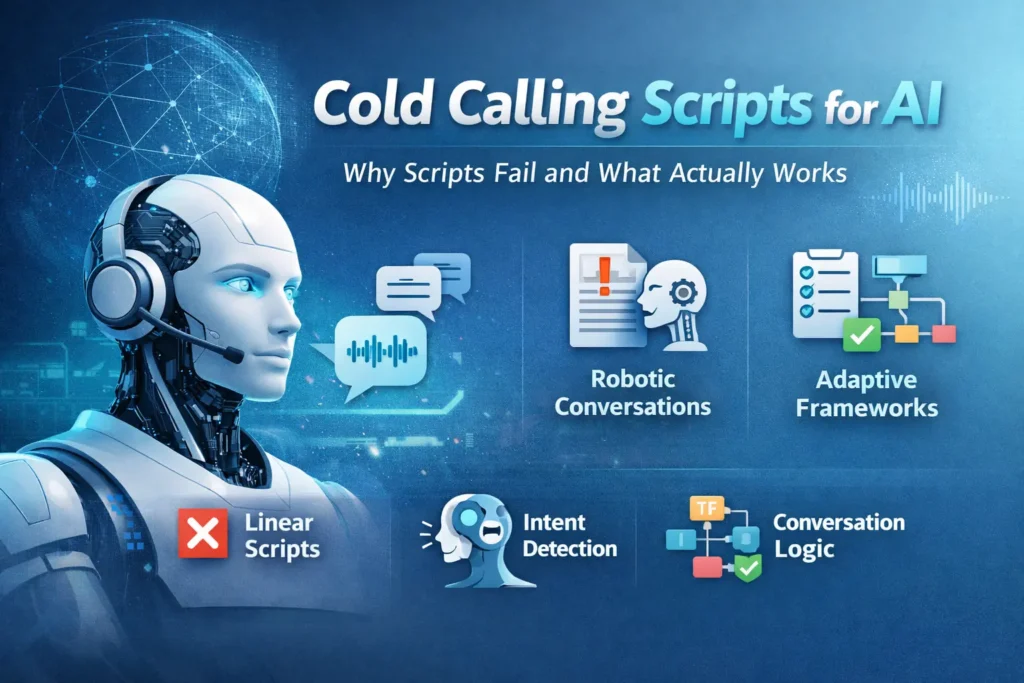

AI appointment setting is often misunderstood.
Most “AI appointment setting guides” frame the problem as calendar automation: how to book more meetings, sync schedules, or eliminate back-and-forth. That framing is incomplete—and in many cases, harmful.
In modern AI outbound and inbound systems, appointment setting is not the goal. It is the result of qualification, intent detection, and decision logic. AI does not exist to fill calendars. AI exists to protect sales time by booking the right meetings—or none at all.
What AI Appointment Setting Actually Means
At a system level, AI appointment setting refers to an AI’s ability to:
- Detect whether a prospect is qualified
- Determine whether intent is real or ambiguous
- Decide whether a meeting is appropriate now
- Route, defer, or exit based on confidence
Scheduling is the final step, not the primary task.
This distinction mirrors the shift away from scripts toward frameworks in AI outbound systems, as explained in Cold Calling Scripts for AI: Why Scripts Fail and What Actually Works.
Why Appointment Setting Is a Hard Problem for AI
Booking a meeting sounds simple. It is not.
In live conversations, AI must interpret:
- Polite curiosity vs real intent
- Deflection disguised as interest (“Send me a calendar ”)
- Authority ambiguity (“I’m not the decision-maker ”)
- Timing friction vs genuine readiness
- Compliance and consent signals
Calendar availability alone does not indicate buying intent. Without proper decision logic, AI systems overbook low-quality meetings that drain pipeline efficiency.
The AI Appointment Setting Lifecycle
AI appointment setting follows a decision lifecycle, not a checklist.
1. Pre-Conversation Configuration
Before any conversation begins, the system is configured with:
- Qualification criteria
- Target roles or authority levels
- Industry and context constraints
- Compliance and exit rules
No appointment logic is triggered yet. This stage defines eligibility, not scheduling.
2. Live Qualification and Intent Detection
During the conversation, AI evaluates:
- Interest signals
- Objection patterns
- Uncertainty and hesitation
- Role clarity
- Timing indicators
This phase relies heavily on NLU-based intent classification, similar to how objections are handled in How NLU Enables AI Systems to Handle Objections Without Scripts.
3. Decision: Schedule, Defer, Route, or Exit
At this point, the AI chooses an action, not a response.
Possible actions include:
- Book a meeting
- Suggest follow-up later
- Route to another workflow
- Exit and suppress
Scheduling is only chosen when confidence thresholds are met.
4. Post-Conversation Resolution
After the interaction, the system records:
- Whether the meeting was appropriate
- Whether future contact is allowed
- Whether suppression is required
- Whether escalation occurred
This feedback loop improves future decision accuracy.
Qualification Comes Before Scheduling (Non-Negotiable)
One of the biggest failures in AI appointment setting is optimizing for meeting volume.
High-performing AI systems prioritize:
- Role relevance
- Problem alignment
- Timing readiness
- Confidence in intent
Booking unqualified meetings:
- Wastes sales capacity
- Degrades rep trust in AI
- Increases churn in AI adoption
This principle aligns with modern AI sales strategy, where conversations—not meetings—are the unit of value.
How AI Decides When to Book an Appointment
AI appointment decisions are driven by confidence, not enthusiasm.
Key decision inputs include:
- Consistency of intent signals
- Absence of unresolved objections
- Clarity of authority or role
- Lack of compliance ambiguity
- Stability of sentiment
When uncertainty is high, the correct outcome is often not scheduling.
When AI Should Not Set an Appointment
A credible AI appointment setting guide must define boundaries.
AI should avoid scheduling when:
- Interest is vague or polite but non-committal
- Objections remain unresolved
- Authority is unclear
- Consent signals are ambiguous
- Emotional resistance is present
In these cases, exiting or deferring protects both compliance and pipeline quality.
Industry Context: Why Appointment Setting Varies
Appointment readiness is not universal.
For example:
- B2B sales often require authority verification
- Regulated industries impose stricter consent thresholds
- Inbound leads behave differently from outbound prospects
This is why appointment-setting logic must adapt by context, as outlined in the AI outbound calling by industry framework.
Common Mistakes in AI Appointment Setting Guides
- Treating calendars as conversion events
- Skipping qualification in favor of speed
- Forcing meetings after soft objections
- Ignoring uncertainty signals
- Measuring success by bookings alone
These mistakes inflate short-term metrics while damaging long-term outcomes.
Key Takeaways
AI appointment setting is not calendar automation. It is a decision system designed to qualify intent, protect sales time, and route conversations appropriately. High-performing AI systems book fewer meetings—but higher-quality ones—by prioritizing confidence, context, and exit logic over volume. Appointment setting works best when treated as the outcome of good decision-making, not the objective itself.
Frequently Asked Questions (FAQs)
These are written to be natural language, citation safe, and ideal for Google AI Overviews, ChatGPT, and Gemini.
1. What is AI appointment setting?
AI appointment setting is a decision process where AI systems evaluate intent, readiness, and context to determine whether a meeting should be booked, deferred, routed, or avoided entirely.
2. Is AI appointment setting just calendar automation?
No. Calendar automation is only the final step. AI appointment setting focuses on qualification, intent detection, and decision logic before any scheduling occurs.
3. How does AI decide when to book a meeting?
AI analyzes conversational signals such as intent strength, unresolved objections, role clarity, and confidence thresholds before choosing scheduling as an outcome.
4. When should AI avoid booking an appointment?
AI should avoid scheduling when intent is ambiguous, objections remain unresolved, authority is unclear, or consent signals are uncertain.
5. Does booking more meetings mean AI appointment setting is successful?
Not necessarily. High-performing AI systems prioritize meeting quality and downstream outcomes over booking volume.