Cold calling scripts for AI are widely misunderstood—and that misunderstanding is responsible for many failed AI calling deployments.
When people search for “AI cold calling scripts,” they usually expect a set of prewritten lines an AI can read during a call. That expectation comes from decades of human outbound sales practices. But AI does not cold call the way humans do. Forcing AI to follow traditional scripts leads to robotic conversations, higher compliance risk, and lower qualification accuracy.
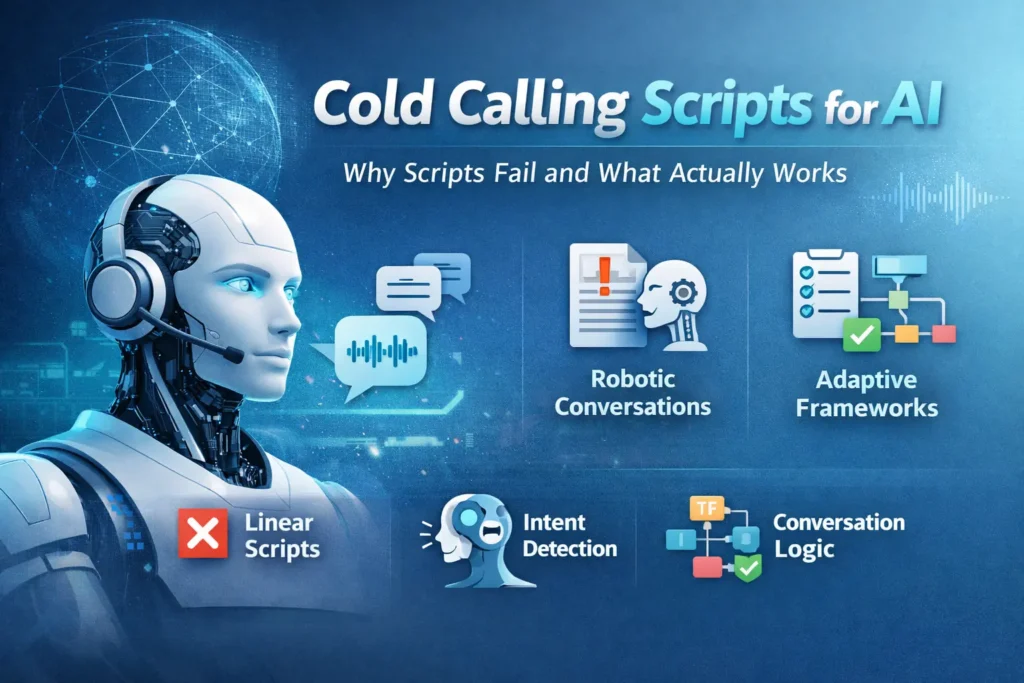
AI does not follow linear scripts. AI operates through conversation frameworks, intent detection, and decision logic.
Understanding this distinction is essential for designing AI cold calling systems that work reliably in real-world sales environments.
What People Mean by “Cold Calling Scripts for AI”
In traditional outbound sales, a cold calling script is a fixed sequence:
- Opening line
- Qualification questions
- Objection handling
- Pitch
- Close
Human sales reps can improvise when conversations drift from the script. AI cannot improvise in the same way—and it should not be expected to.
When scripts are applied directly to AI, teams assume:
- The AI should read from a script
- Deviations can be handled with branching responses
- More scripting equals more control
In practice, this approach breaks down quickly in live conversations.
Why Traditional Cold Calling Scripts Fail With AI
Here’s why traditional cold calling scripts fail with AI:
Cold Calls Are Inherently Non-Linear
Prospects interrupt, redirect the conversation, hesitate, or disengage entirely. Linear scripts assume cooperation. AI must react to signals, not wait for its next line.
Over-Scripting Makes AI Sound Robotic
Prewritten responses introduce unnatural pacing and repetition. In real-time voice systems, excessive scripting can even increase response delays, compounding issues related to latency in AI voice systems and making conversations feel artificial.
Scripts Do Not Enforce Compliance Dynamically
Compliance is not a one-time disclosure at the start of a call. Opt-outs, refusals, and ambiguity often occur mid-conversation. Scripted flows are not designed to detect and act on these signals in real time, which is why TCPA compliance requires more than approved language alone.
Scripts Optimize for Pitching, Not Qualification
Most scripts are built to move toward a pitch. AI cold calling works best when it filters and qualifies, not persuades. Over-scripted AI tends to push when it should disengage.
Script Maintenance Does Not Scale
As scripts grow, so do branching paths and failure points. This creates brittle systems that are difficult to audit, update, and govern.
What Replaces Scripts in AI Cold Calling
What people call “AI cold calling scripts” are more accurately conversation control frameworks. These frameworks align with modern AI sales strategy and outbound system design rather than traditional copywriting.
Instead of memorized lines, effective AI cold calling relies on five core components.
Conversation Goals (Not Pitches)
Each AI call should have one narrow objective, such as
- Determining qualification fit
- Confirming relevance or interest
- Identifying the appropriate next step
AI should not be tasked with persuasion or closing. This principle is foundational to any AI-first outbound strategy and is explored in depth in the AI sales strategy for outbound teams framework.
Intent Detection
Rather than following a script, AI continuously evaluates:
- Interest
- Confusion
- Objection
- Disinterest
- Opt-out intent
Responses are selected based on what the prospect signals, not on a predetermined script position.
Guardrails
Guardrails define what the AI must not do, including:
- Over-explaining
- Pitching aggressively
- Continuing after clear disinterest
- Ignoring compliance signals
These constraints are far more important than clever wording and are central to safe, compliant AI calling systems.
Exit Conditions
Human scripts often assume the call continues unless the prospect hangs up. AI requires explicit exit logic, such as:
- Direct or indirect opt-outs
- Repeated negative sentiment
- Non-responsive behavior
- Time-based thresholds
Knowing when to stop is as important as knowing how to start.
Escalation Rules
AI must know when to:
- Transfer to a human
- Schedule follow-up
- Route to another workflow
- End the interaction entirely
These rules prevent AI from exceeding its role in the outbound process.
Human Script vs AI Conversation Framework
Traditional Human Script (Simplified):
“Hi, this is Alex calling from [Company]. We help businesses improve [X]. Is now a good time to talk?”
AI Conversation Framework (Conceptual):
- Opening intent: detect availability and receptiveness
- Identify interruption or hesitation
- If receptive → confirm relevance
- If unclear → ask one clarifying question
- If resistant → acknowledge and exit
This difference explains why AI outbound calling workflows vary significantly by context and industry, as outlined in the AI outbound calling by industry guide.
Common Mistakes When Designing AI Cold Calling “Scripts”
Here are some common AI cold calling “script” mistakes to avoid:
Treating AI Like a Junior SDR
AI is not a trainee that needs rigid instructions. It is a system designed to classify signals at scale.
Forcing AI to Pitch
Pitching increases call duration, reduces trust, and raises regulatory risk without improving qualification accuracy.
Ignoring Mid-Call Opt-Out Signals
Opt-outs are often indirect. AI must treat hesitation, deflection, and refusal seriously to remain compliant with U.S. calling regulations.
Overloading AI With Objection Trees
More branches increase complexity and error rates. Simpler decision logic performs better in live environments.
Writing for Control Instead of Outcomes
The goal is not perfect phrasing. The goal is consistent, low-risk qualification.
When Scripts Still Matter in AI Cold Calling
Scripts are useful, but their role is limited.
They are appropriate for:
- Required legal disclosures
- Approved brand tone guidance
- Short, standardized openers
- Compliance-specific language tied to regulatory obligations
In regulated environments governed by TCPA and FCC rules, these scripted elements must be paired with real-time detection and enforcement logic, not treated as full conversations.
Key Takeaways
Cold calling scripts for AI are not scripts in the traditional sense. AI succeeds by interpreting intent, operating within guardrails, and exiting conversations intelligently. Organizations that force human scripting models onto AI systems often create robotic interactions and unnecessary compliance risk. Modern AI outbound calling replaces scripts with structured conversation frameworks that adapt to real-world variability, industry context, and regulatory constraints.
FAQs
Can AI follow a cold calling script?
AI can reference approved language, but it does not follow scripts line-by-line. It operates using intent detection and decision logic rather than memorized sequences.
Do AI cold calls sound robotic?
They do when overscripted. AI sounds more natural when responses are selected based on real-time signals instead of rigid scripts.
Are scripts required for AI cold calling compliance?
Some disclosures may require scripted language, but compliance depends primarily on real-time opt-out detection and exit enforcement, not full call scripts.
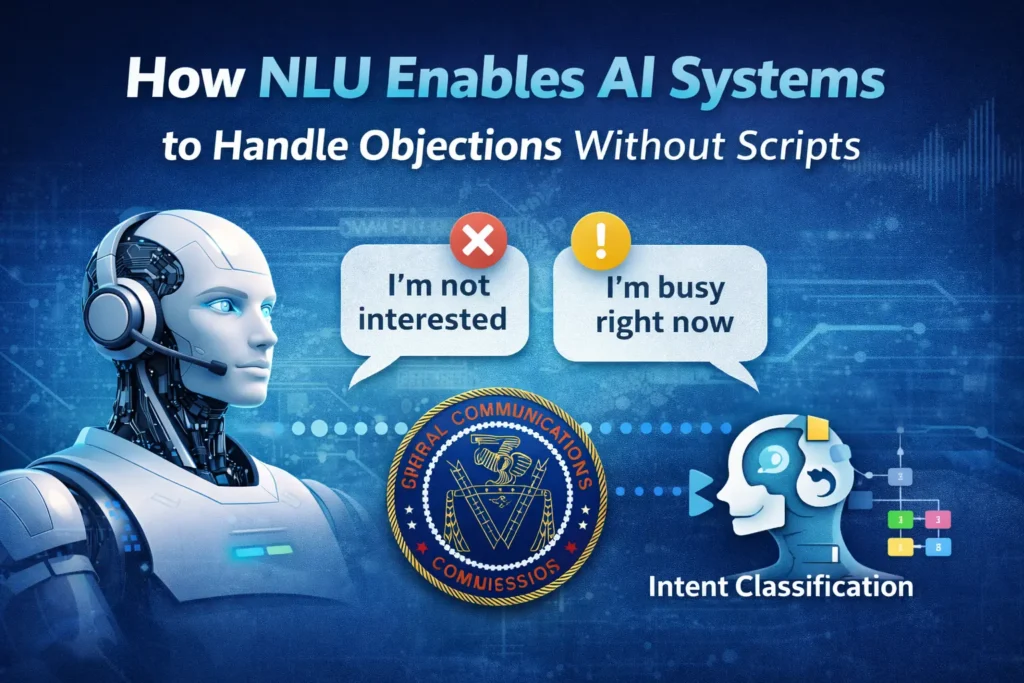
How does AI handle objections without scripts?
AI classifies objections by intent and responds according to predefined rules rather than scripted rebuttals.
What is the biggest mistake companies make with AI cold calling scripts?
Trying to make AI sell instead of qualify. AI performs best when focused on filtering and routing conversations, not persuasion.