In this blog, we will explore:
- What a Call Flow Is and Why It Matters
- The Core Elements of an Effective Call Flow
- Types of Call Flows and Where They Fit in the System
- The Infrastructure Behind Call Flow Design
- How to Design and Build a Call Flow That Actually Works
- What Is the Integration, Compliance, and Testing Layer of a Call Flow?
- Common Mistakes to Avoid
- How to Keep Improving the Experience
What a Call Flow Is and Why It Matters
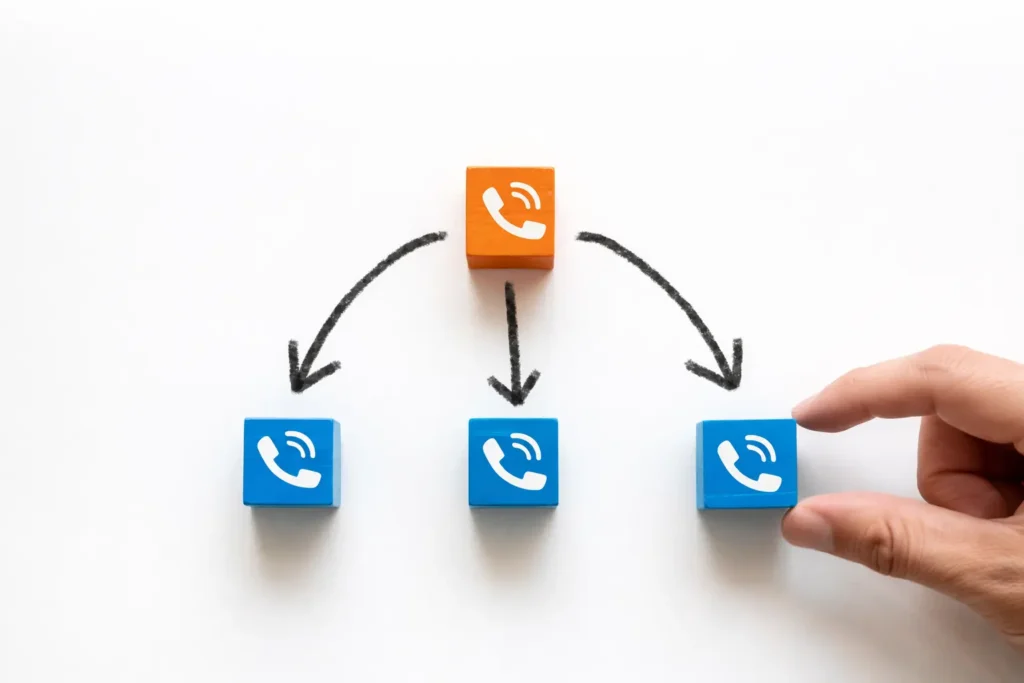
A call flow is essentially a map or a diagram of a call path as the call goes from the beginning to the end of the call, from the moment that the caller dials the call as it routes through the system, delivered to the actual agent that they speak with, and to the end of that call. It defines all the steps that are going to take place as the call progresses.
The Core Elements of an Effective Call Flow
The core elements of effective call flow include when, what, where, and how of the call.
- When of a call: when are we going to route it to a contact center agent versus routing it to an after-hours message option.
- What of a call: what are we going to do with that caller while we have them on the line, including decision points or points to gather information potentially from the caller.
- Where of a call:: where are we going to send this call now that we have gathered the right information or know who we are talking to. It may be routed to an agent in a formal queue, to a hunt group, or given some other automated experience.
- How of a call: how the agent experience and the customer experience are going to be delivered, what the agents need in front of them to do their job effectively, and what experience is ultimately intended for the customer.
Especially in this day and age, there is access to so much information and the ability to easily tap into that information using APIs. This allows the agent’s experience to be supercharged so that they know exactly who they are speaking with, the why that caller is calling, and potentially even information that says they are calling about this, this is the third time they have called, and this solution should be recommended for them. Intelligence can be added as AI continues to make its way into the contact center.
Modern call flows are not just routing systems, they are helping agents to have all the tools that they need to do their job most effectively.
Explore More: Why AI-Human Handoffs Are Breaking Customer Experience (And How to Fix Them)
Types of Call Flows and Where They Fit in the System
Call flows are not one single structure. They exist as different layers inside the contact center. And each layer is designed to deal with particular stage of interaction
1. Inbound Call Flow
An inbound call flow defines what happens when a caller reaches out to your organization. These are not random interactions. The caller has intent. They are already in your system.
When the callers are already in the customer service system they have intent and it’s not just a random conversation. The most typical scenario of inbound call flow are:
- A customer calling about an issue
- A customer making a payment
- A prospective customer asking about services or products
The inbound call flow is responsible for capturing that intent and directing it correctly without adding friction.
2. Outbound Call Flow
An outbound call flow is fundamentally different because the system initiates the interaction. The agent is not reacting but leading. The outbound call flow defines: what is said first, what questions are asked, and how the conversation progresses once the call is answered.
This is commonly used in cold calling, follow-ups on inbound leads, sales and telemarketing, collections and fundraising In outbound environments, structure matters even more because the first few seconds determine whether the conversation continues or ends.
3. Intake Call Flow
The intake call flow is the control layer at the start of the interaction. It determines why the caller is calling, what information needs to be captured, and where the call should go next
This applies to both inbound and outbound interactions. The main purpose of intake work flow is to gather the right information as quickly as possible and route the call to the correct path. A well-designed intake flow directly prevents misrouting and reduces unnecessary handling time.
4. Troubleshooting Call Flow
Once the intent is identified, the system moves into resolution. A troubleshooting call flow is designed to handle problem-solving scenarios.
Its typical pattern include starting with the most common causes, moving through guided steps, and eliminating possibilities until the issue is resolved
The main purpose of troubleshooting workflow is efficient resolution, minimizing time while maintaining accuracy.
5. Compliance and Regulated Procedure Scripts
Call flows are structured prompts not scripts. However, certain parts of the interaction cannot be flexible and need to be scripted. These parts include compliance disclosures, legal language, and regulated procedures.
In these cases, the call flow must enforce exact phrasing to ensure regulatory compliance, consistency across interactions and risk mitigation.
6. Complex Process Call Flow
Some interactions are not linear. They require branching logic.
A complex process call flow is built around conditional paths: If this happens, then do this. If not, move to another path.
These flows include multiple decision points, multiple possible outcomes, and deep branching structures.
Because of that, they must be designed to cover all possible scenarios. If even one path is missing, the system breaks.
7. Closing Call Flow
The part is the most overlooked but it is very important because it is the final touchpoint and leaves a lasting impression.
The closing call flow defines what agents would say at the end of interaction and whether the issue is fully resolved or not?
The ending ensures that the interaction is complete, the customer understands the outcome, and no steps are missed.
The Infrastructure Behind Call Flow Design
Creating a call flow requires coordination from multiple people and systems. Information has to be pulled from different resources to create a cohesive design that supports everything needed throughout the process.
Even in a short three-minute call, there can be essential elements involved. These may include resolving the issue, positioning new products to the customer, and capturing data for reporting. This allows trends to be identified and performance metrics to be measured agent by agent and queue by queue.
Phone system
To make all of this work properly, the phone system must be considered first. It defines how calls are delivered to agents and what they use to handle the interaction. The system must be capable of supporting these requirements, or if transitioning, it must align with the next solution.
System requirements
System requirements are equally important. This includes having the right network infrastructure and proper desktop systems for agents. At this stage, telecommunications and IT professionals are already involved.
Security requirements
Security must also be addressed because multiple systems and data sources are accessed. CRM or ticketing systems are part of the process, which may require developer support for integrations.
Functional requirements
Then come the functional requirements. The contact center manager has to be involved to make sure agents have all of the tools they need to do their job effectively, supervisors have the visibility and control they need, and agents have access to the tools to effectively handle that interaction.
Omni-channel interactions
Omnichannel interactions may also be part of the setup. This includes not just voice calls, but also web chat, email, and SMS, all managed within the same contact center environment.
Finance
Finance also plays a role, as investment approval is required to support the system.
All of these factors must be considered because they determine where the system fits within the organization and how it interacts with other parts of the business.
How to Design and Build a Call Flow That Actually Works
The first place to start is with the customer experience. Since this is a customer-facing tool, it should be designed in a way that gives the customer experience that is wanted. If that means exceptional service, then the design has to reflect what it takes to give that exceptional service through this approach and this system.
Second, integration needs should be taken into consideration. Systems are needed to give that agent access to the information, resources, screen pops, and actual tools they are using while handling that interaction so they have the information and ability to resolve that issue on the first call.
Third, all the system needs must be considered. The question is whether the infrastructure that is needed is already in place, or whether that infrastructure will have to be strengthened to support all the different technology elements that are going to be factored into the call flow and contact center solution.
Then prompts must be determined by taking into consideration all possible iterations of what may occur in a call. It is easy to think of the questions to ask and the optimal answers, but sometimes the answer that is expected is not received. The design has to accommodate mistakes, errors, and situations where data is not captured and the question has to be asked again. All of those things have to be factored in to make sure that the flow is complete.
Lastly, test, test, test. The call flow has to be tested thoroughly and any adjustments that are needed should be made, because this is a live customer-facing element once it is active. It has to reflect the professionalism that is wanted from the company.
What Is the Integration, Compliance, and Testing Layer of a Call Flow?
When thinking of the systems that are typically integrated within a contact center, they usually fall into two categories: a customer relationship management database or CRM, or a ticketing system or some other functional system used to facilitate processes through a company.
A ticketing system can facilitate the closure of a ticket. An ordering system can track the order, make sure that it gets delivered on time, and support “where is it” types of questions. Whatever the system might be, it gives the ability to tap into that information both on the front end for the customer in an automated fashion and in order to help route that call to the right team.
If a ticket number is entered and it can be seen that it is a hardware-related issue, that call can be routed to the hardware team rather than some other team that is not equipped to answer that type of interaction. It gives the ability to use that information to effectively route the call and provide information back to the caller.
Sensitive data handling really comes down to the design and making sure that sensitive data is data that can be shared and how it is going to be shared through the call flow. It has to be determined what information is going to be provided to that customer or caller and whether it is something that can be shared per compliance. In healthcare, for example, with HIPAA requirements, care has to be taken about what information is shared and that it is being shared with the appropriate person.
One way to validate that is through unique identifiable information such as an account number, a patient ID, or an order number. Depending on the nature of the call, that information can be used to get follow-up information behind it. Accessing that information also needs to be secure, so security standards have to be considered in order to properly authenticate access to that data and make sure that whatever information is being retrieved is being retrieved in an authorized manner.
Testing can be as simple as making some phone calls, but there should also be some load testing and functional testing at the same time. Notes should be made during the test process to identify little changes that may need to be made in the flow, and testing should be done in a non-live environment if possible, using a test number before making it live for customers.
Common Mistakes to Avoid
There are some common mistakes that lead to broken call flows, poor customer experience, and lower resolution rates. Let’s discuss them
Excessively Long Prompts
One of the most frustrating things that callers face is excessively long prompts, such as having to listen to a three-minute message before they can do anything. Thought needs to be put into that so those situations do not exist.
Too Many Options
Too many options can also be a problem. If there are nine options, callers may not remember the first couple of options by the time they get to eight or nine. Options should be kept very succinct, and if there need to be that many options, they should be broken up and subcategorized.
Query Loops
Another common issue is query loops. There should not be a lot of looping where customers get stuck in a cycle they cannot get out of. If there is a situation where a response is not received and the system asks the question again, it should be designed in an effective way so there are exit points to get them to another phase of the process or directly to an agent.
Making Changes Without Testing
Another mistake is making changes on the fly. It is better to test and validate rather than roll the dice and make a big change live unless it is absolutely necessary.
Not Defining All the Scenarios
Another mistake is not defining all the scenarios, especially what happens if the response that is being looked for is not received. If those scenarios are not thought through, it creates confusion points for the caller.
How to Keep Improving the Experience
Preparation is key. A call flow is an essential part of the first impression many callers are going to get, or maybe the only impression that year if the only time they call is for support.
Getting buy-in from all of the key stakeholders
Another essential part is getting buy-in from all of the key stakeholders. There can be a lot of departments involved depending on how large the company is, and a lot of buy-in is needed because many systems and many aspects of the company are being touched.
Always ready to modify call flow as per need
It is also important to be prepared to adjust as needed. It is not likely that it will be perfect the first time. There should be willingness to adjust it as needed and also to think outside of the box about what new elements can be incorporated to make the experience even better for the callers.
Benchmarking Against High-Performing Call Flows
Calling into other customer service lines that are admired is a good way to get an idea of what should be accomplished. Calling a bank is a great example because automated systems are commonly used throughout those calls. It is also useful to see what competitors are doing and whether they are using some technology that is giving them an edge in the market, or whether that is the opportunity to go above and beyond where the competition sits.
Building Measurability into the System
Measurability is also critical. There should be as much measurability in the contact center as possible: reports on agents, reports on queues, feedback from customers, and some kind of a closed loop in place not only to receive the information but to learn from it and implement things that take that feedback into account.
FAQs about Call Flow
1. What is a call flow and why does it matter?
A call flow is essentially a map or a diagram of a call path from the moment that the caller dials the call, as it routes through the system, delivered to the agent, and to the end of that call.
2. What are the core elements of an effective call flow?
The core elements of effective call flow include when, what, where, and how of the call.
3. What does the “when” of a call flow define?
The “when” of a call defines when the call is routed to a contact center agent versus routing it to an after-hours message option.
4. Why are compliance and regulated procedure scripts important in call flows?
Certain parts of the interaction cannot be flexible and need to be scripted. These parts include compliance disclosures, legal language, and regulated procedures. In these cases, the call flow must enforce exact phrasing to ensure regulatory compliance, consistency across interactions and risk mitigation.
5. Why is testing important in a call flow?
The call flow has to be tested thoroughly and adjustments should be made because it is a live customer-facing element once it is active.
6. What are some common mistakes that lead to broken call flows?
Common mistakes include excessively long prompts, too many options, query loops, making changes on the fly, and not defining all the scenarios.