What Is Post Call Analysis in AI Voice Systems?
Post call analysis is the process through which information is extracted from conversation after the call ends. By default, several details are extracted from each call. These include the call recording, cost, duration, phone numbers involved, agent name, agent ID, and call ID. Conversation analysis includes call success, user sentiment, disconnect reason, and voicemail detection when enabled. A call summary and transcript are also provided.
At the conclusion of every call, a post-call message or post call analysis is sent to two places. After every call, an end-of-call message containing those details is created and sent to the call history. If a webhook is configured at the agent level, the same message is sent through the webhook to the automation platform where it was created. That information can then be used to create a call dashboard where performance can be reviewed, assessed, and improved.
Explore More: Real-Time Communication Challenges in AI Voice Assistants and a Multi-Layer Audio AI Stack Approach
How Post Call Analysis Works Technically
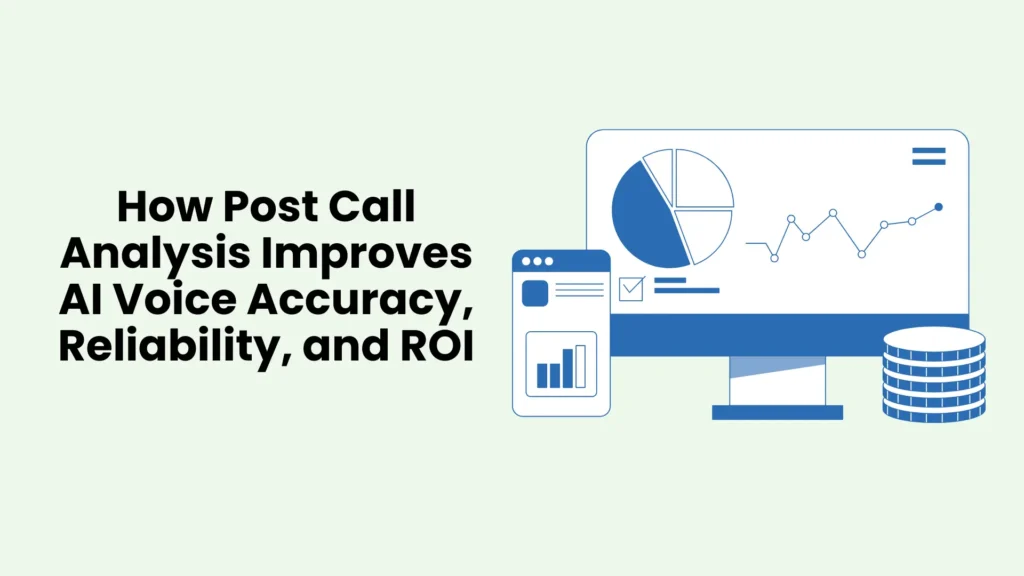
Post call analysis messages are received through a webhook and processed in an automation platform. The extracted data is then used to update a call dashboard with fields such as date, caller number, first name, call outcome grade, call summary, transcript, recording, and improvement recommendations.
The Three Post Call Analysis Strategies
The following three post call analysis strategies are game changers for delivering and maintaining high-performing voice AI systems. Let’s have a look at them!
1. Collecting Customer Information During the Call
The first post call analysis strategy is collecting customer information during the call if it is provided. This includes extracting dynamic variables such as first name, email, or address. Collecting this information is especially useful for first-time callers and follow-up conversations, allowing for better personalization.
2. Assigning a Call Outcome Grade
The second strategy is the call outcome grade. This analyzes the call transcript against the prompt and categorizes the outcome as either a pass or a fail. If the call fails, a failure reason is generated to support improvement. This provides a high-level view of voice agent performance without manually reviewing every transcript.
3. Generating Improvement Recommendations
The third strategy is generating improvement recommendations. After every call, the system analyzes the prompt and transcript and automatically produces recommendations to improve the voice assistant’s performance. A structured output format ensures these recommendations are actionable.
Reviewing the call dashboard allows verification of accurate data capture, correct call outcomes, clear summaries, and actionable improvement suggestions. Improvement recommendations highlight areas such as repeating appointment details for clarity or asking follow-up questions before ending the call.
Because voice agents handle a wide range of call reasons and scenarios, the recommendation section is critical for continuous improvement. The combination of customer data extraction, call outcome grading, and automated improvement recommendations enables delivery of high-quality voice agents consistently.
The difference between high-performing voice AI systems and underperforming ones lies in how post call analysis is used. The above strategies focus on continuous, call-by-call improvement. But some organizations rely on big batch analysis that takes a long time to move from analysis to results. Let’s explore the limitations of big batch post call analysis.
Limitations of Traditional Post Call Analysis Approaches
Post-call analysis can make conversations better and build stronger customer relationships, but how useful it becomes depends on who is using it and how they use it. Some users want to do post call analysis through large batch analyses, where they analyze a million calls at once and develop models. Certain teams are very good at this approach.
However, there are two major problems with this method. The first is that lead time becomes extremely long. Big batch analysis requires months to put together a model, which means it takes a long time to move from analysis to results. The second problem is what happens after the model is built. The model is usually handed to a sales leader or customer service leader, but there is often no clear way to apply that model at scale across all sales and customer service teams throughout an entire contact center.
These are key bottlenecks and challenges in post call analysis. Even though the ability to dig in and mine insights is useful and can surface valuable findings, the practical impact is limited.
How to Use Post Call Analysis in AI Call Centers?
The true purpose of post call analysis is never about extracting exclusive information about conversation to make reports, rather it’s about using extracted insights right away to improve the upcoming AI calls and conversations.
One important purpose is call deflection and interaction deflection. This involves identifying different reasons people call in and using that information to change IVR flows or chatbots so they can proactively handle those cases.
Post call analysis is also valuable for marketing and product research through voice of the customer insights. Interest in the voice of the customer was very high a few years ago, but it has declined because organizations have struggled to turn those insights into something useful. This represents what the past of post call analysis looks like and the limited ways it has delivered ROI so far.
In AI calling, the purpose of post call analysis is shifting toward immediate insight delivery. As soon as a call ends, analysis should trigger instantly and surface a meaningful insight. That insight should not be a graph or a number, but a clear sentence that explains what needs attention.
To prevent post call analysis from getting stuck or bottlenecked, there needs to be a way to act on those insights immediately. There must be a clear action that can be taken as soon as the insight appears, turning insight directly into results. This connection between insight and action is critical.
Turning Post Call Analysis Into Measurable Business Impact
Post call analysis is not done to merely grade any conversation or call; rather its main purpose is to use it in a productive way by applying improvement recommendations to future conversations.
The first approach to convert post call analysis into measurable business impact is analyzing calls after they happen and producing recommendations that highlight what is working and what is not. These recommendations may show that a specific question, value proposition, or explanation is effective a certain percentage of the time.
With a simple action, that effective message can be shown to all agents on their next calls. Ineffective messages can also be removed immediately so no one continues using them. This ability connects post call analysis directly to the real-time experience agents have when speaking with customers. What is learned after a call directly impacts how future calls are handled.
It is critical to connect what is said during calls with whether it worked or did not work. This turns post call analysis from a basic recommendation engine into a powerful A/B testing system. While marketing has used A/B testing for centuries, sales and customer service conversations inside contact centers have largely not been tested this way.
By tying spoken content to outcomes, it becomes possible to see how different ways of discussing pricing or explaining offers affect success rates. Some approaches lead to successful outcomes far more often than others, and those differences can be measured and acted upon.
These analytics rely on models that identify successful calls and APIs that allow organizations to feed real win and loss data directly from their systems. This creates a true source of truth by linking conversation behavior directly to business outcomes. The result is not just better insights, but a system where learning, action, and performance improvement happen continuously.
FAQs about Post Call Analysis
1. What does post-call analysis extract in AI voice systems?
Post call analysis extracts information from conversation after the call ends. By default, several details are extracted from each call. These include the call recording, cost, duration, phone numbers involved, agent name, agent ID, and call ID. Conversation analysis includes call success, user sentiment, disconnect reason, and voicemail detection when enabled. A call summary and transcript are also provided.
2. How does post-call analysis improve AI voice accuracy?
The information extracted after call conclusion can be used to create a call dashboard where performance can be reviewed, assessed, and improved.
3. Why is real-time post-call analysis better than traditional batch call analysis?
There are two major problems with traditional batch call analysis. The first is that lead time becomes extremely long. Big batch analysis requires months to put together a model, which means it takes a long time to move from analysis to results. The second problem is what happens after the model is built. The model is usually handed to a sales leader or customer service leader, but there is often no clear way to apply that model at scale across all sales and customer service teams throughout an entire contact center.
4. How does post-call analysis increase ROI in AI calling?
Post-call analysis increases ROI by turning insights into immediate changes, reducing errors, improving agent performance, enabling call deflection, and continuously optimizing conversations.