AI call centers unintentionally collect personal data in the form of names, phone numbers, email addresses, locations and financial, insurance, or health-related details depending on the vertical. Unlike human agents, AI agents won’t forget this information instinctively; rather they store it by default unless they are engineered not to do so. This information that was previously a momentarily necessity has now been permanently restored and can be searched and accessible even after the caller’s purpose has been completed.
AI call centers rarely collect personal data intentionally. But in this case, the issue is not intent but architecture. AI systems are designed to optimize performance. For this purpose, calls are recorded for quality assurance, they are transcribed for data analysis, systems reuse recordings and historical data to improve scripts, routing, and models. They quietly transform a single phone call into a dense, persistent repository of personal information.
Many AI call centers rely heavily on consent as a shield against compliance related issues . Consent is essential, but it is limited to the purpose of the interaction. It does not automatically authorize unlimited reuse of personally identifiable data across downstream systems. When call recordings and transcripts are later used for analytics, training, auditing, or vendor tooling, the data may be processed in ways that were never clearly communicated to the consumer.
From a regulatory and litigation point of view, this creates a gap between lawful communication and lawful data handling. In traditional call centers, such compliance issues were often contained to a single process. But in AI call centers, the same issue can multiply across many processes like recordings, transcripts, and analytics, increasing overall risk.
Therefore, a single unredacted transcript can simultaneously raise issues under Telecom regulations, privacy laws, and sector-specific rules and result in penalties and charges.
In this blog, I will tell you about PII redaction and why it is very important especially for AI call centers that unintentionally collect personal information as part of a call artifact but can be interpreted as a violation.
What Is PII Redaction?
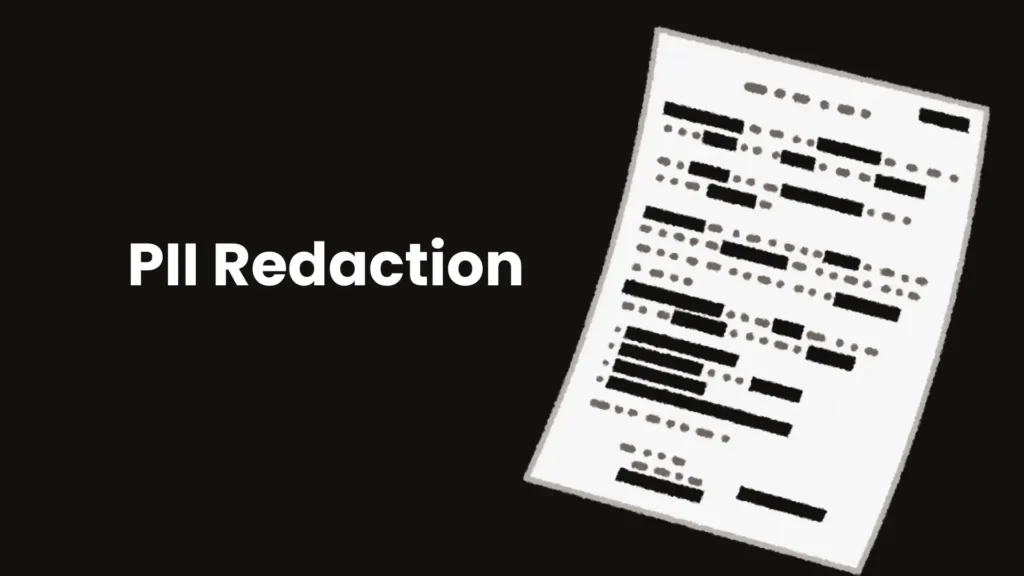
Personally Identifiable Information (PII) is defined as information that can be used to trace an individual’s identity like names, phone numbers, email addresses, locations and financial, insurance, or health-related details. PII Redaction is the act of masking or hiding this information for any use other than its consented purpose.
Why PII Is Harder to Control in AI Call Centers
PII is difficult to control in an AI call center because AI turns the momentary information that is part of a regular calling procedure into persistent data. In traditional call centers, human agents forget personally identified information or become part of basic CRM notes. Whereas in an AI call center, call is not just responded to, rather it is recorded, transcribed, analyzed, shared with other tools via integrations, and often reused to train AI systems. And each of these additional steps increase the chance that personal data spreads farther than intended.
When the system converts speech into text during transcription, it changes the risk profile. Audio converted into text format becomes structured data that can flow through AI calling architecture.
This is why major contact-center platforms specifically offer transcript and audio redaction: they recognize that transcription increases downstream exposure if sensitive fields aren’t removed.
AI training creates secondary processing risk because call centers reuse data for script improvement, intent models, disposition predictions, agent coaching, summarization and QA automation. At this point most of the compliance and privacy risks concentrate as data is used beyond consented purpose. In privacy terms, it is referred to as secondary use/secondary processing. And this can raise serious compliance issues that can escalate into serious privacy violations.
Even if your calling itself is compliant, using un-redacted recordings and transcripts for training can raise many serious privacy questions because training pipelines share data across different systems and without redaction, personal identifiers can be passed into systems that do not need them rather increase unnecessary risks.
Moreover, AI call center architecture consists of voice platform, speech-to-text systems, analytics and QA, CRM, helpdesk, data warehouse, BI dashboards, and LLM summarization. Each tool introduces another copy of the data, and another access surface.
This excessive access results in unauthorized exposure via too many systems, too many logins, too many exports, too many retention buckets. That’s why leading AI calling platforms enable redaction so sensitive fields don’t propagate into downstream tools in the first place.
Explore more: What Is the National Do Not Call Registry and How It Limits Outreach Call
What Types of PII Appear in AI Call Center Calls
In AI call centers, personal information is asked during verification, scheduling, quoting, eligibility checks, and follow-ups; so PII appears too often.
The most common PII categories you will come across during call; especially during insurance, debt, elder care, health insurance, home services, and real estate outreach and engagement calls are:
- Direct identifiers
- High-risk sensitive data
- Biometric identifiers
1) Direct identifiers
They are the most obvious identifiers that reveal the identity of a person immediately without any effort if they appear in transcripts or recordings. Direct identifiers include:
- Phone numbers
- Full names
- Email addresses
- Physical addresses
2) High-risk sensitive data
These are the fields that create the biggest compliance and breach impact. They often appear during qualification, verification, payment, or policy details parts of a call. Sensitive data include:
- Financial details like bank account references, card numbers, income, hardship details, payment arrangements. Card verification values (CVV/CVC) are considered sensitive authentication data under PCI DSS and must not be stored after authorization.
- Insurance and policy numbers
- Health-related information like treatments, eligibility, claims, or benefits
- Authentication data like PINs, OTPs, passcodes
3) Biometric identifiers
Biometric identifiers are the unique physical or behavioral characteristics that can be used to recognize a person’s identity. In case of AI calling biometric identifiers are:
- Voice recordings
- Voice embeddings in AI systems are used to identify people via voice patterns and features; that data is treated as biometric information under privacy laws like California’s CPRA.
How PII Redaction Works in AI Call Center Systems
A well-maintained, compliant and responsible call center built redaction into the entire data flow with the sole purpose to keep only useful parts of conversation for QA, coaching and training while preventing identities from spreading across different phases of voice interaction and pipeline.
Mature call centers redact PII in following ways:
- redact during transcription
- Post-call transcript sanitation
- Audio muting of sensitive segments
- tokenize before training/analytics
- restrict raw access by role
Let’s discuss them in detail!
Real-time transcript redaction
In transcript redaction, identities are hidden and masked during transcription.
In most service centers, PII is masked after transcription either manually or automatically. As the transcript is created and copied first across various systems and redaction is done afterward so it becomes difficult to ensure that all copies are fully sanitized.
In the transcript redaction process, the speech-to-text system has a mode called identify and redact mode. It looks for PII after audio is converted into text, and redact personal details like phone numbers, names, addresses, emails, or payment information by replacing them with labels such as [PII] or [REDACTED_PHONE]. This whole process occurs before saving the transcript and sending it to agents or supervisors.
Post-call transcript sanitation
Once the realtime transcript redaction is performed during call, post-call transcript sanitation is done as a second pass to sanitize the transcript of any PII that system missed during live transcription process.
Post-call sanitation serves as a quality filter before the transcript is moved and saved to other systems like QA tools, CRM notes, analytics warehouses, and BI dashboards. Post-call transcript sanitation has strict rules and it looks for tricky cases like phone numbers present in the form of spoken words instead of digits.
Post-call transcript sanitation is important because AI-based redaction during transcription is not perfect and does not guarantee the removal of every single PII.
Audio muting of sensitive segments
The text redaction only removes PII from transcripts but audio still contains all the personal information intact. In audio muting, the sensitive information or PII is either removed from recording or masked via beeping the segment where PII was spoken.
Only redacted audio is available to agents and supervisors for QA, training, and coaching. Raw audio is restricted, and available only to high-level management only when necessary, for example, during audits.
Tokenization before AI training
AI call centers continuously train their AI agents to optimize their performance. For this purpose, recording and transcripts are fed in data pipelines to train models to learn about objections, intents, outcomes, and compliance signals.
To keep the PII from entering data pipelines tokenization is done by replacing identifiers with stable tokens. For example:
- John Smith is replaced by PERSON_1042
- +1-415-555-0199 is redacted in the form of PHONE_7781
- Policy #A12345 is masked as POLICY_5520
In highly mature systems, if there is a way to extract PII from redaction labels, that link is kept locked or not kept at all if it isn’t needed.
Role-based access to raw data
In highly responsible call centers, not everyone has access to the same kind of information. Access to information is separated into tiers like agent and training teams can only access redacted transcript and redacted audio for training and QA purposes, reviewer and supervisor can access redacted transcript and raw audio, whereas only high-level management, security and compliance teams can access raw transcript and raw audio.
Why AI Call Centers Must Implement PII Redaction
In AI call centers, service and outreach calls are recorded and transcribed. Transcription converts audio PII into written and structured form that can be searched and reveal the identity of the call’s recipient.
Beside this, the transcript is saved and shared across various systems for different purposes. The more the data is used, the higher is the chance of unauthorized access. PII redaction breaks this chain by removing identity early, so that you can use this data for purposes like model training, coaching, and analytics without fear of unauthorized access.
PII redaction is one of the few ways that an AI call center uses to stay compliant with laws and regulations like TCPA, HIPAA, GLBA etc.
Let’s learn how PII redaction helps AI call centers to stay compliant!
1) Preventing TCPA consent scope problems and FCC scrutiny
TCPA does not directly ask to redact call recordings but redaction is very important for TCPA compliance with respect to recipients consent. Under TCPA, the callers must take consent from the receipt that they agree to receive an AI call for a particular purpose that is enlisted on the consent.
When a call is made, recordings are transcribed, stored and used for AI model training and other purposes. This means that information is used beyond the consented purpose as the recipient was not told that his/her information is used for secondary purpose. This creates compliance risks and can lead to penalties and charges.
To reduce the risk of non-compliance under TCPA, PII reduction is done to temper the information so privacy of common citizens cannot be breached and information can be used in a productive way, too.
2) Supporting HIPAA regulations in health and elder care
If your call center deals with health related services and outreach activities like health insurance or elder care, you will have to comply with HIPAA rules, too.
It has two clauses that need immediate attention with respect to call center compliance. Under HIPAA, companies should only use and share minimum health information needed to do the required job.
Call transcripts related to health are often studded with PII in the form of full names, addresses, policy numbers, and health-related information. PII redaction helps to comply with this clause by removing extra PII and teams can review calls for desired purpose without sensitive health data.
Moreover, HIPAA de-identification guidance treats biometric identifiers including voice prints as identifiers because they can be directly used to reveal the identity of call’s recipient. That’s why controlling access to call recordings and removing sensitive parts from audio is especially important in health-related calls.
3) Meeting GLBA Safeguards Rule duties in insurance and financial services
If your AI call center deals with insurance and debt-related services, you are legally responsible to protect customers’ financial information under the Gramm-Leach-Bliley Act (GLBA).
GLBA expects your call centers to protect customer information, limit its access, and properly secure systems to prevent leakage and misuse under the Safeguards Rule 16 CFR Part 314.
As we already discussed, recording calls, transcription and sharing recorded and transcribed information is the normal part of AI call center’s workflow, therefore GLBA-related duties apply. And PII redaction, access controls, and secure storage are used to comply with these obligations.
4) Reducing exposure under state privacy laws
State privacy laws increasingly focus on two principles that collide with AI call center workflows:
- Purpose specification: According to this rule, AI call centers can only collect and use data for the stated purpose rather than secondary use like AI models training.
- Biometric protections: If your systems use voiceprints or voice embeddings to identify or recognize individuals, that data can be treated as biometric information and requires stronger protections under privacy laws.
AI call center data tends to get reused. Redaction and tokenization help you keep the operational value while reducing identifiability, which aligns with minimization and purpose limits.
FAQs about PII Redaction
1: Why do AI call centers unintentionally collect so much personal data?
AI call centers unintentionally collect personal data in the form of names, phone numbers, email addresses, locations and financial, insurance, or health-related details depending on the vertical to perform service and outreach tasks.
2: Why is personal data risk higher in AI call centers than traditional call centers?
In traditional call centers, agents forget PII instinctively and PII is limited only to CRM notes. Whereas, AI systems are designed to optimize performance. For this purpose, calls are recorded for quality assurance, they are transcribed for data analysis, systems reuse recordings and historical data to improve scripts, routing, and models. They quietly transform a single phone call into a dense, persistent repository of personal information.
3: Does customer consent allow AI call centers to reuse call data freely?
No, consent is essential, but it is limited to the purpose of the interaction. It does not automatically authorize unlimited reuse of personally identifiable data across downstream systems. When call recordings and transcripts are later used for analytics, training, auditing, or vendor tooling, the data may be processed in ways that were never clearly communicated to the consumer.
4: What types of personal data commonly appear in AI call center calls?
PII that appears in call center are in form of
- Direct identifiers: Names, phone numbers, emails, addresses
- Sensitive data: Financial details, insurance or policy numbers, health information, authentication codes
- Biometric identifiers: Voice recordings or voice embeddings used for recognition.