Handling objections has always been one of the hardest parts of outbound sales. For human sales reps, objections are emotional, ambiguous, and often indirect. For AI systems, they are even harder—because objections are rarely explicit, consistently phrased, or delivered in isolation.
This is why handling objections via NLU (Natural Language Understanding) is not about scripted rebuttals or prewritten responses. It is about detecting, classifying, and acting on resistance signals in real time, often under strict latency and compliance constraints.
In modern AI outbound calling systems, objection handling is not a sales tactic. It is a language classification and decision-making problem.
Why Objection Handling Is Hard for AI Systems
Unlike structured inputs, objections in live calls are
- Vague (“I’m not sure”)
- Deflective (“Send me something ”)
- Time-based (“Call me later”)
- Emotional (“I’m frustrated with calls like this ”)
- Regulatory (“Put me on your do-not-call list ”)
A single sentence can carry multiple meanings at once. AI systems cannot assume intent—they must infer it.
This complexity is why traditional cold calling scripts fail in AI environments and why modern systems rely on NLU instead of scripted objection trees, as discussed in Cold Calling Scripts for AI: Why Scripts Fail and What Actually Works.
What NLU Actually Does in Objection Handling
NLU is the layer responsible for transforming raw speech or text into structured meaning.
When handling objections, NLU performs several functions simultaneously:
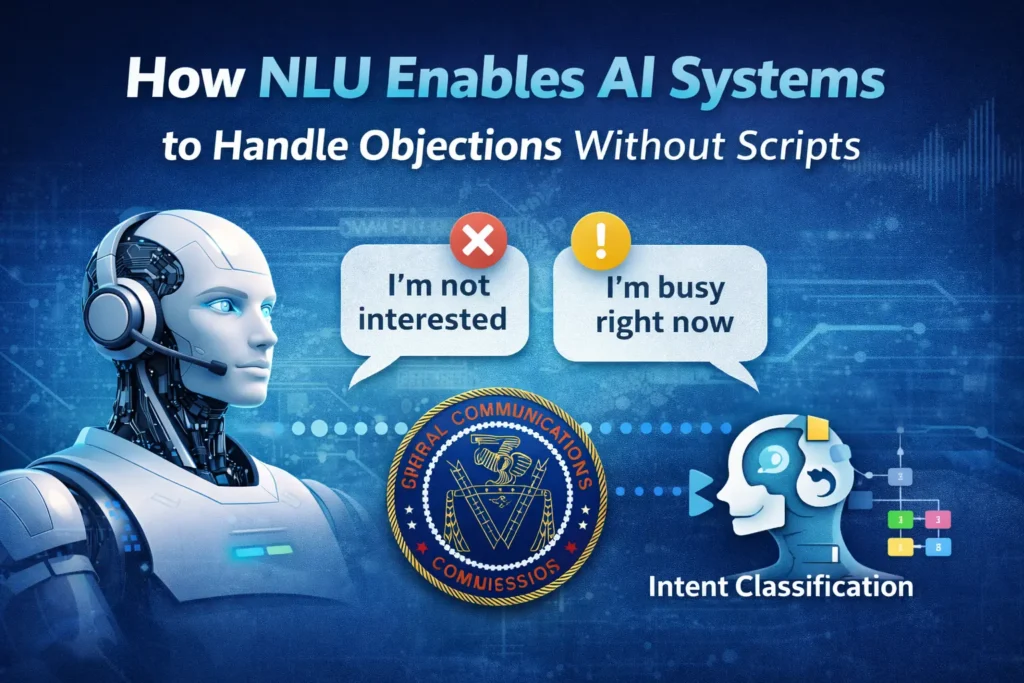
- Intent classification—determining what the speaker is trying to accomplish
- Semantic parsing—understanding the meaning of phrases beyond keywords
- Sentiment detection—identifying frustration, neutrality, or hostility
- Confidence scoring—estimating how certain the system is about its interpretation
These processes happen before any response is selected. In other words, NLU decides what kind of objection is being expressed before the AI decides what to do next.
Objection ≠ Rejection (A Critical Distinction)
One of the most common mistakes in AI objection handling is treating all resistance as rejection.
In reality, objections fall into multiple categories:
- Soft resistance—hesitation, uncertainty, mild pushback
- Deflection—requests to delay or redirect (“Email me,” “Not now”)
- Hard rejection—explicit refusal or opt-out
- Contextual barriers—timing, authority, or relevance issues
NLU systems are trained to distinguish between these categories because each requires a different outcome.
For example:
- “I’m busy” may indicate timing friction, not disinterest
- “Not interested” may be conversational shorthand rather than a legal opt-out
- “Take me off your list” is a compliance-triggering signal that requires immediate exit
Failing to make these distinctions increases both conversion errors and regulatory risk.
The Real-Time Constraints of Objection Handling
Objection handling does not happen in batch mode. It happens live, during active conversations.
This introduces strict constraints:
- Responses must occur within milliseconds to feel natural
- Intent classification must be fast and reliable
- Over-analysis introduces delays that break conversational flow
That is why objection handling is closely tied to low-latency AI calling architectures, not just language models. Excessive processing time can cause interruptions, overlaps, or awkward pauses—signals that reduce trust.
Your existing work on reducing latency in voice AI systems and the technical foundations behind high-performance AI calling systems directly applies here.
How AI Decides What to Do After an Objection
Handling objections via NLU follows a structured decision flow:
- Detect an objection signal
- Classify the type of resistance
- Assess confidence in the classification
- Apply guardrails (compliance, tone, scope)
- Choose an action, not just a response
Possible actions include:
- Ask one clarifying question
- Acknowledge and disengage
- Escalate to a human
- End the call and suppress future contact
Importantly, responding is optional. In many cases, the correct action is to exit the conversation. This aligns with modern AI sales strategy, where AI is responsible for filtering and routing conversations—not persuading at all costs.
Common Mistakes in AI Objection Handling
Let’s look into some common mistakes in AI objection handling:
Treating Objections as Scripted Events
Prewritten rebuttals assume predictable phrasing. Objections are not predictable.
Forcing AI to Overcome Resistance
Pushing back against objections often increases friction and compliance risk without improving outcomes.
Ignoring Uncertainty Scores
When NLU confidence is low, continuing the conversation is risky. Conservative exits are safer.
Overfitting Training Data
Training only on ideal objection examples causes failure in real-world variability.
Conflating Sales Goals with Safety Goals
Objection handling must prioritize safety and compliance over conversion metrics.
There are specific situations where AI should not handle objections at all.
There are clear boundaries where AI systems should disengage or escalate:
- Explicit legal opt-outs
- Heightened emotional distress
- Ambiguous consent scenarios
- Regulated or high-risk conversations
In these cases, exiting is not a failure—it is correct system behavior. This principle is closely tied to TCPA compliance and broader legal requirements for AI calls, where improper handling of objections can create serious exposure.
Key Takeaways
Handling objections via NLU is not about crafting better responses—it is about building systems that can accurately detect, classify, and act on resistance in real time. AI succeeds in objection handling when it prioritizes intent recognition, confidence assessment, and safe decision-making over scripted persuasion. Organizations that design objection handling as a language understanding problem—not a sales script problem—build more reliable, compliant, and effective AI calling systems.
FAQs
How does NLU detect objections in AI calls?
NLU analyzes intent, semantics, and sentiment to identify resistance signals, even when objections are indirect or ambiguous.
Can AI handle objections better than humans?
AI can be more consistent at classification, but it must be designed to exit or escalate appropriately rather than always respond.
Is objection handling scripted in AI systems?
No. Scripts may provide approved language, but objection handling is driven by intent detection and decision logic.
What happens when NLU is uncertain?
Well-designed systems prioritize conservative actions, such as clarification or disengagement, when confidence is low.
Are objections the same as opt-outs?
No. Some objections indicate hesitation, while others trigger legal opt-out requirements. NLU systems are designed to distinguish between them.