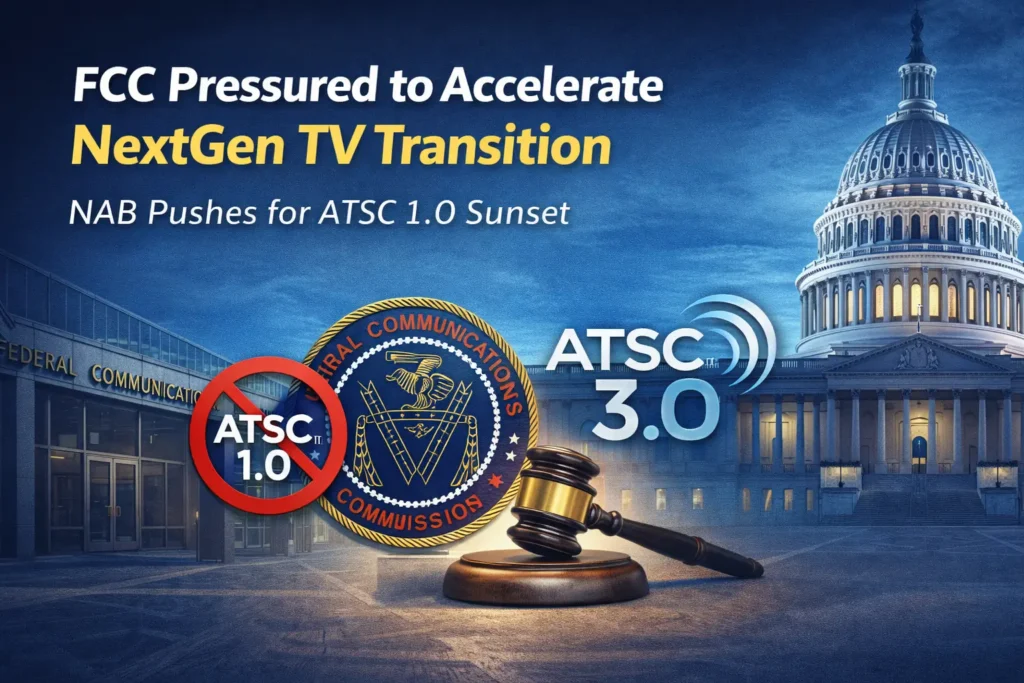
The Federal Communications Commission is facing renewed pressure to accelerate the transition from ATSC 1.0 to ATSC 3.0, also known as NextGen TV, following a new filing by the National Association of Broadcasters.
In comments submitted to the FCC on January 20, the NAB urged the Commission to move the ATSC 3.0 rollout beyond its current limited implementation phase and establish policies that would enable a full, nationwide transition.
According to the filing, the FCC has a “timely opportunity” to advance NextGen TV deployment in a way that serves the public interest, strengthens broadcast infrastructure, and enables long-term planning across the industry.
What the NAB Is Asking the FCC to Do
In its filing, the NAB called on the FCC to take several concrete actions to accelerate the transition.
These include:
- Establishing a date-certain sunset for ATSC 1.0
- Modernizing receiver standards so consumers can reliably receive authorized ATSC 3.0 broadcast services
- Ensuring continued MVPD carriage of broadcasters’ primary ATSC 3.0 signals and associated features
- Reaffirming a stable approach to content protection that supports high-value programming without disrupting consumer viewing expectations
While the FCC has indicated interest in liberalizing certain broadcast rules, it has not yet taken a formal position on two of the NAB’s key proposals: setting a firm cutoff date for ATSC 1.0 broadcasts and requiring that all new television sets support ATSC 3.0 reception.
This regulatory uncertainty mirrors challenges seen in other communication technologies, where evolving FCC rules and enforcement guidance directly affect how systems are designed, deployed, and governed, as outlined in the broader overview of legal requirements for AI calls and FCC disclosure obligations.
Proposed ATSC 1.0 Sunset Timeline Remains Unresolved
Although the most recent NAB filing does not specify a firm shutdown date, the association has previously advocated for a phased sunset of ATSC 1.0 signals—targeting 2028 for larger markets and 2030 for the rest of the country.
According to the NAB, a clear sunset timeline would allow broadcasters, manufacturers, and distributors to plan more effectively, reduce long-term costs, and avoid confusion for consumers.
The Consumer Technology Association has opposed mandatory tuner requirements, citing concerns around cost, consumer choice, and implementation complexity.
The filing also addressed issues related to content security, privacy, and emergency systems.
The filing also addressed several technical and regulatory issues that have generated resistance from smaller device manufacturers and some broadcasters.
On privacy, the NAB argued that additional broadcast-only privacy rules are unnecessary and potentially counterproductive. The association stated that ATSC 3.0 does not introduce new privacy risks for viewers who watch over-the-air broadcasts without an internet connection.
“A one-way broadcast signal, with no return path, cannot collect or transmit viewer information,” the filing argued, asserting that watching ATSC 3.0 over the air is no different from ATSC 1.0 from a privacy standpoint.
This distinction between one-way transmission systems and interactive communication models is a recurring theme in U.S. communications regulation and is also central to ongoing debates around why TCPA compliance matters for AI calling systems, where real-time data exchange and user consent play a much larger role.
The NAB also maintained that the transition to ATSC 3.0 would not disrupt Emergency Alert System operations and could ultimately enhance spectrum efficiency.
Why This Matters Beyond Broadcast Television
Although the current debate is focused on broadcast standards, the FCC’s handling of the ATSC 3.0 transition has broader implications for the evolution of U.S. communications infrastructure.
ATSC 3.0 is designed to support:
- More efficient use of spectrum
- Improved signal robustness
- Data-enabled broadcast capabilities
- Complementary positioning, navigation, and timing services
As communications technologies become increasingly software-driven and AI-assisted, regulatory clarity around spectrum use, disclosure obligations, and system design becomes more consequential. Under existing TCPA and FCC enforcement frameworks, similar regulatory principles already shape the construction, deployment, and governance of AI-powered voice and outreach systems.
What Happens Next
The FCC continues to evaluate policy options related to the ATSC 3.0 transition. While the agency has signaled openness to reform, it has not yet committed to a nationwide ATSC 1.0 sunset date or universal ATSC 3.0 receiver mandate.
The NAB’s latest filing increases pressure on the Commission to provide clearer timelines and regulatory direction—decisions that could influence not only the future of broadcast television but also the broader trajectory of U.S. communications infrastructure modernization.