What are the New HarmonyOS 6.1 AI Call Features?
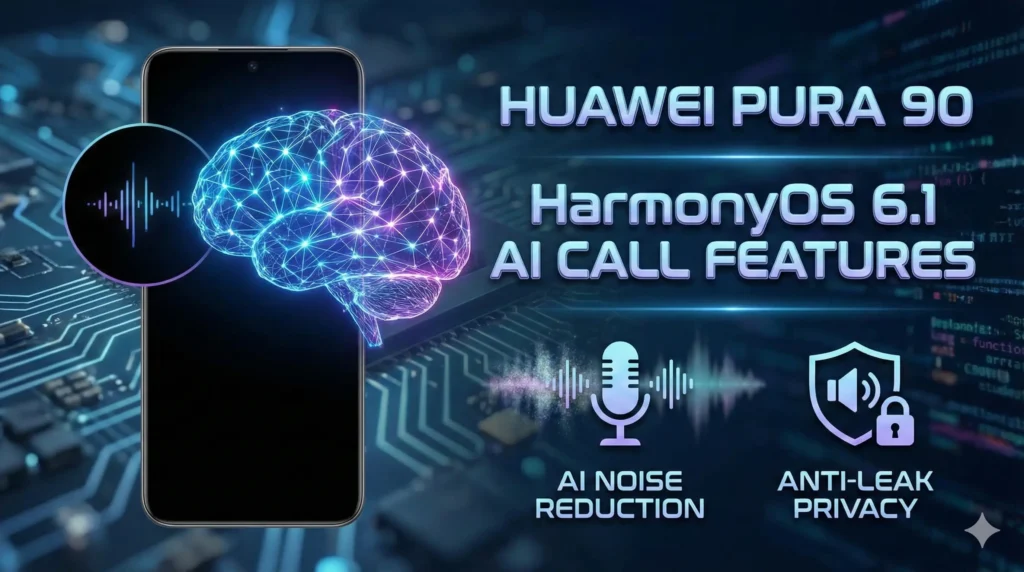
The upcoming HarmonyOS 6.1 (debuting on the Huawei Pura 90) introduces hardware-integrated AI features, including Two-Way AI Noise Reduction, which cleans audio for both the caller and recipient, and Triple Diaphragm Anti-Leak technology to prevent bystanders from overhearing private conversations.
For the AI outbound industry, these features establish a new hardware benchmark for Acoustic Privacy and Call Clarity, essential for high-stakes B2B and Healthcare sales.
The Tech Impact: Two-Way AI Noise Reduction
Most current AI calling systems focus on “Inbound” noise cancellation (cleaning the mic). The Pura 90 leak suggests a shift toward Two-Way Processing.
- The Impact on Outbound Sales: In a 2026 environment, your AI agent might be calling a prospect who is driving, in a busy airport, or on a construction site. Two-way noise reduction ensures the AI “hears” the prospect clearly and the prospect “hears” the AI perfectly, regardless of their environment.
- Strategic Benefit: This reduces Inference Errors (where the AI misinterprets what the prospect said due to background noise), directly increasing the Qualified Conversation Rate (QCR).
Acoustic Privacy: The “Triple Diaphragm” Solution
The leak highlights a “triple diaphragm anti-leak” feature designed to keep call audio from leaking out of the handset’s speakers.
- Why it Matters for B2B: In industries like Finance, Healthcare, and Law, privacy is a strategic constraint. If a professional is using a mobile device to interact with an AI Sales Agent, they must be certain that the conversation is not being overheard by others in a public space.
- The “Privacy Shield” Benchmark: As AI calling becomes the standard, hardware that enforces Acoustic Privacy will become a requirement for high-ticket sales interactions where sensitive data is discussed.
Offline Communication & Resilience
The Pura 90 series reportedly enhances Offline Communication capabilities. For AI outbound calling, this signals a move toward Edge-AI Inference.
- The Analysis: Traditionally, AI voice agents rely 100% on cloud connectivity. If the connection drops, the conversation dies. Huawei’s move toward enhanced offline tech suggests a future where the “Brain” of the AI agent can live on the device itself.
- Strategic Shift: This reduces Latency (removing the cloud round-trip) and ensures that sales motions aren’t interrupted by poor signal, a critical factor for field sales and outdoor service industries like Solar and Home Services.
The “Infrastructure vs. Hardware” Comparison
As a revenue leader, you must distinguish between software-level AI and hardware-integrated AI.
| Feature | Software-Only AI (Legacy) | Hardware-Integrated AI (2026) |
| Noise Filtering | Basic mic-side cancellation | Two-way machine learning cleanup |
| Latency | Dependent on Cloud/API | Edge processing (Instant response) |
| Privacy | Software encryption only. | Physical “Anti-Leak” hardware drivers |
Strategic Glossary for this News
- Acoustic Privacy: The physical limitation of sound leakage from a device ensures that only the intended recipient hears the call.
- Two-Way AI Noise Reduction: The simultaneous cleaning of background noise for both the sender and the receiver using on-device neural processing units (NPUs).
- Edge-Inference Calling: AI voice interactions are processed locally on the device hardware rather than in the cloud, reducing latency and increasing reliability.
Key Takeaways for US Sales Leaders
Despite restrictions on Huawei’s hardware availability in the US, this leak offers a competitive roadmap.
- Expect Latency to Drop: As hardware-level AI becomes the standard, “Speed-to-Response” will become a competitive battleground.
- Privacy as a Sales Feature: Future AI outbound strategies will need to emphasize “Privacy-Safe” calling environments to win trust in regulated industries.
- The Rise of High-Fidelity Voice: Static, “tinny” AI voices are being replaced by hardware-optimized, high-fidelity audio that is indistinguishable from human callers.
FAQs
1. What is AI Two-Way Call Noise Reduction?
AI Two-Way Call Noise Reduction is a machine-learning technology that filters background distractions from both the microphone (sender) and the speaker (receiver) in real-time. In 2026, this technology is critical for AI Outbound Calling because it ensures the AI agent correctly interprets the prospect’s intent even in high-decibel environments, significantly reducing Inference Errors.
2. How does the “Triple Diaphragm Anti-Leak” feature improve call privacy?
The Triple Diaphragm Anti-Leak feature uses specialized hardware drivers to focus sound waves directly toward the user’s ear, preventing audio from “bleeding” into the surrounding environment. This is a game-changer for professional privacy, allowing users to conduct high-stakes sales or healthcare calls in public spaces without the risk of bystanders overhearing sensitive information.
3. What is the benefit of Hardware-Native AI vs. Cloud-AI for voice agents?
Edge-AI, also known as Hardware-Native AI, processes voice and data directly on the device’s chipset instead of sending it to a server far away. This results in sub-500 ms Latency, which is the “Trust Threshold” for human-like conversation. It also ensures call stability in areas with poor internet connectivity, making it essential for field-service industries like Solar and Real Estate.
4. Will HarmonyOS 6.1 AI features be available in the US market?
While Huawei’s hardware remains restricted in the US, the debut of HarmonyOS 6.1 sets the global benchmark for 2026. These features (Two-Way Noise Reduction and Anti-Leak audio) are expected to be the “Standard Requirements” that US-based competitors like Apple and Samsung must adopt to maintain parity in the AI-driven sales market.
5. Can AI noise reduction improve the ROI of outbound sales?
Yes. By improving the clarity of the conversation, AI noise reduction increases the Qualified Conversation Rate (QCR). When prospects can hear and be heard clearly, trust is established faster, and the “miscommunication bounce rate”—where a call is ended due to audio frustration—is virtually eliminated.