When businesses grow, customer interaction volume increases. This demands accurate and consistent communication. Due to economic constraint, pressure to control operational costs, increased focus on agent productivity and retention, globalization, distributed customer bases, data-driven decision making and technological advancement; traditional call centers are null and void and not useful at all especially for mid-sized to large businesses.
Traditional call centers entirely depend on human agents and manual processes and are therefore failing to keep up with newly emerging business needs and demands. Moreover, customers are very sensitive to how they get treated. They have plenty of different options available to switch to them when they feel neglected and disrespected. Under such circumstances, sticking to traditional methods is not a practical option and results in high operational cost with reduced satisfaction among customers, and least growth.
As modern problems need modern solutions therefore automated call centers are the best solution for growing business needs. These platforms help businesses manage high volume customer interaction while maintaining consistent communication within optimum budget.
What Are Automated Call Center Solutions?
Automated call center solutions are AI based systems that handle customer interaction using advanced technologies like machine learning, natural language processing and understanding, automatic speech recognition, conversational AI, sentiment analysis etc. with least to no human intervention.
Automated call center solutions are designed to deal with newly emerging businesses needs especially related to customer interaction.
- They are capable of dealing with high call volumes especially during business expansion or during peak seasons.
- They maintain consistent communication by being available all the time, not just during business hours.
- They reduce operational and labor costs especially when finance is a major constraint for growth.
Core Components of an Automated Call Center Solution
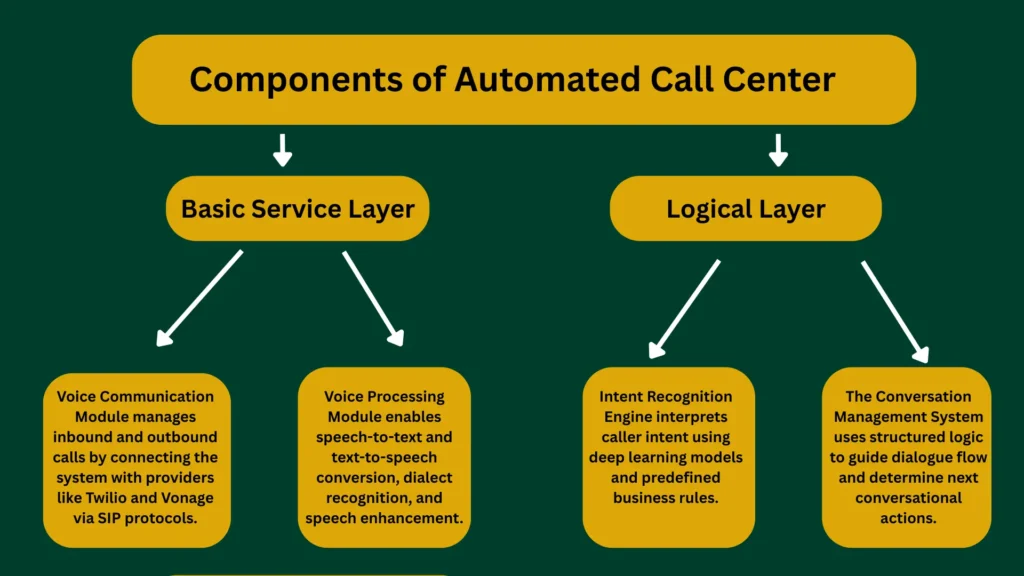
The core components of an automated call center solution consist of two main layers:
- Basic Service Layer
- Logical Layer
Basic Service Layer
The basic service layer is the technical foundation of an AI calling system. The main function of this layer is to make sure that phone calls happen and voices are sent and received without any malfunction.
Basic layer has two main components:
- Voice Communication Module
- Voice Processing Module
Voice Communication Module
The voice communication module is responsible for making and handling phone calls. It connects the AI system with third-party communication service providers like Twilio, Vonage, Bandwidth, Telnyx etc. using SIP protocol stack.
This module completes fundamental communication functions such as call establishment, call transmission, encoding and decoding voice signals etc. It also handles complex communications issues like unstable networks, delays in audio transmission, or echo in phone calls.
Voice Processing Module
The voice processing module includes automatic speech recognition and text-to-speech services. This module allows the system to perform speech-text conversions and handle dialect recognition, sentiment analysis, speech enhancement etc. Usually, AI call centers do not build this module from scratch rather depend on professional suppliers like Alibaba Cloud Tencent Cloud iFlytek etc.
Logical Layer
The logical layer is the brain of the AI calling system. It makes decisions about what the AI should say, how it should respond, and how the conversation should continue.
It consists of two subunits:
- Intent recognition engine
- Conversation management system
Intent Recognition Engine
The intent recognition engine helps in understanding what the person is trying to communicate. It utilizes deep learning models such as BERT Transformer with predefined business rules to understand natural language and intricate semantics along with strict calling policies.
Intent recognition engine understands intent in three steps:
- It listens to what the person says
- Understands how and where the conversation is going
- Figures out the underlying need or interest
Conversation Management System
The conversation management system utilizes state machine models to control the flow of the conversation. It guides the conversation using branching logic pathways, decides when the AI should ask questions, provide information, or end the call. This ensures that the conversation stays on track.
Modern systems improve over time via reinforcement learning techniques and A/B testing frameworks to test different script versions to find out what works best. High-Performance AI calling systems are designed to allow smooth call handover to human agents when conversations become complex or reach sensitive points.
Explore more about: Technical Foundations behind High-Performance AI Calling Systems
Key Features Businesses Look for in Automated Call Center Tools
If any business is looking for an automated call center, it’s very important to choose the one that provides them with all the following features.
- Intelligent Call Routing
- AI-driven chatbots and Virtual Assistants
- Sentiment Analysis
- Predictive Dialing Software for Outbound Calls
- Omnichannel Communication
- Real-Time Analytics and Reporting
- Agent Assist Technology
- Scalability and Customization
- Compliance and Transparency
1. Intelligent Call Routing
Intelligent call routing connects customers to the most suited agent based on their skills, language, and interaction.
For example: a Spanish customer comes with a billing query and it’s a complex problem that needs to be solved by a human agent. The AI agent routes it to the billing expert who can speak Spanish.
The intelligent call routing reduces delay time by handing over calls to the correct agent automatically and enhances first call resolution rates that increases customer satisfaction.
2. AI-driven chatbots and Virtual Assistants
AI chatbots and virtual agents deal with simple day to day queries like FAQs, schedule appointments, or offering basic troubleshooting. This relieves human agents to deal with creative queries that require human cognition.
3. Sentiment Analysis
Using sentiment analysis, automated call centers gets an accurate idea of tone and emotion behind callers words and identifies either customer is upset, happy, or neutral.
It allows agents to respond in a way that helps to defuse tense situations. If any call is rated as negative sentiment by AI systems, it could trigger a supervisor to take over and make sure the issue is addressed promptly.
4. Predictive Dialing Software for Outbound Calls
Predictive dialing software is an outbound call automation snystem that simultaneously dials multiple phone numbers from the contact list and uses AI and statistical algorithms to predict agent availability. Auto dialers are mostly used by lead generation and sales teams in outbound call centers.
It dial numbers even before the agent completes their previous call and thereby reduces idle time to maximize agent productivity.
5. Omnichannel Communication
Using omnichannel integration, automated call centers maintain consistent communication across all platforms like voice, email, chat, and social media. Suppose, if a customer initiates a query on social media and later switches to phone call or email, the customer won’t have to repeat their information again. Omnichannel Communication guarantees agents access to full interaction history for personalized service.
6. Real-Time Analytics and Reporting
Call center software tracks key performance indicators (KPIs) such as average handle time, call volume, and customer satisfaction scores and allows management and the agents to make data-driven decisions and strategies.
7. Agent Assist Technology
Agent assist tools provide recommendations and resources while agents are interacting with a customer and give prompts for specific solutions based on what customers ask. These tools increases agent confidence, helps resolve issues more quickly, and ultimately leads to an improved customer experience.
8. Scalability and Customization
Scalability means your automated call center grows as your business. If more agents are required during the peak season, the automated call center can be scaled up using AI without need of any hiring. And during off seasons, AI call centers can be scaled down easily.
9. Compliance and Transparency
One of the most important features businesses should look for in an automated call center is compliance and transparency. Before dialing any number, AI call centers must take consent properly from recipients about receiving automated calls. They must also keep call records so businesses can easily review and track interactions when needed.
Popular Automated Call Center Tools and Platforms
Automated call center tools help businesses manage different tasks of their call center. These tools are available separately or in the form of a package. Businesses can get them based on their needs and requirements.
Some of the important automated call center tools include:
- Helpdesk Software
- CRM Software
- Desktop Softphone and Mobile App
- Interactive Voice Response
- Automatic Call Distribution
- Call Recording
- Call Recording
- Call Queue Management
- Predictive Dialer
- Dashboards and Call Analytics
- Compliance and Security Tools
Helpdesk Software
Helpdesk software is a central hub that consolidates every message regardless of its source into a unified interface. They use intelligent triage for intelligent call routing.
This unified interface prevents the agents from toggling between tabs.
Key Providers of helpdesk software are:
- Zendesk
- Freshdesk
- Nextiva
- HubSpot Service Hub
CRM Software
The CRM platform provides complete data of each customer and synchronizes data across all channels.
For instance, when an agent receives a call, features like screen pop instantly display the entire history of the customer. This helps agents provide personalized service without customers having to repeat themselves.
Key Providers of CRM Software include:
- Salesforce Service Cloud
- HubSpot
- Microsoft Dynamics 365
Desktop Softphone and Mobile App
Automated contact centers use Contact Center as a Service (CCaaS) solutions to provide them with desktop softphones and mobile apps. These software applications allow center agents to make and receive calls to and from any internet-enabled device.
VoIP providers include.
- RingCentral
- 8×8
- Dialpad
Interactive Voice Response (IVR)
Interactive voice response (IVR) is an automated telephone system technology that provides self-service to customers and enables them to receive, provide information or make requests by using voice or menu inputs.
IVR providers include:
- Genesys
- Nuance
- Amazon Connect
Automatic Call Distribution (ACD)
The ACD is a software that performs the intelligent call routing, matching customers with the best-suited agent based on predefined rules.
Its working mechanism involves:
- identifying high-value customers from your CRM
- moving them to a priority queue
- ensuring that important clients always receive prompt service.
Automatic call distribution providers include
- Five9
- Talkdesk
- Avaya
Call Scripting
Call scripting software helps agents by providing dynamic conversation guidance and prompts during the call when the agent is handling the caller.
Some of the key providers are:
- Balto
- Salesforce Einstein
- Oracle Service Cloud
- Zendesk Guide
Call Recording
Call center platforms record and transcribe all conversations and store them in searchable archives. Call recording tools help record all the calls and have integrated emotion and sentiment analysis features that automatically flag calls where customers show negative emotions and help in prompt solutions.
Call recording providers:
- Nextiva
- Verint
- CallMiner
- NICE
Call Queue Management
During busy lines, call queue management tools send callers to a virtual line and provide dynamic wait time estimates and a callback option when the agent is free.
Call queue management providers include :
- Nextiva
- Bigly Sales
- Talkdesk
- Genesys
Predictive Dialer
Predictive dialers are tools that use an AI algorithm to dial multiple phone numbers simultaneously. They filter out busy signals and dropped lines, so agents do not waste time waiting for someone to pick up the call and only connect agents when a person answers the call.
Predictive dialer providers are :
- Five9
- Bigly Sales
- Genesys
- Aspect
- NICE
Dashboards and Call Analytics
Call analytics tools provide customizable dashboards with practical and live insights into important metrics like call volume, average handle time, and first-call resolution. They also help in forecasting future call volumes and staffing needs.
Key providers include:
- Nextiva
- Bigly Sales
- Tableau
- Microsoft Power BI
- Calabrio
Compliance and Security Tools
Call centers often deal with sensitive data that must adhere to strict regulations like PCI DSS for payments and HIPAA for healthcare. Moreover, automatic calling requires TCPA compliance and prompt consent from the recipient before dialing their number .
Usually security tools are built directly into software to mitigate compliance risks.
Key Types of Integrations for Automated Call Center
Integration means connecting the call center system with other business tools.The main purpose is to share information between call centers and other business tools so they act coherently. Each integration is designed for a unique purpose and understanding each one of them is very important for business to know which is most suitable for their functions and operations.
Some of the important integrations are:
- CRM integrations
- Cloud telephony integrations
- Help desk and ticketing system integrations
- Omnichannel integrations
- API-Based Integration
CRM integrations
CRM integrations connect call centers with customer databases that allow agents to view complete biodata and history of customers during call. Easy access to each customers’ information allows agents to provide personalized services and solutions to their problems.
Cloud telephony integrations
Cloud telephony integration allows businesses to connect cloud-based phone systems with business software through a connector layer like Zoho PhoneBridge, Twilio Flex Plugins, Cisco Webex Calling Integrations etc.
Help desk and ticketing system integrations
Help desk and ticketing system integrations connect call centers with businesses support platforms. When a customer calls, the integration can create a new ticket or update an existing database with call details such as the issue, time, and outcome.
Omnichannel integrations
Omnichannel integration connects all your communication channels like phone, email, web chat, WhatsApp, Facebook messenger, Instagram, Telegram to your call center platform. It keeps the information of customers from all the channels on one integrated platform.
API-Based Integration
API integration is function-based integration that allows businesses to build custom connections via APIs. It is important for businesses with unique workflows. APIs allow call center software to adapt to their unique workflows and needs.
Business Use Cases of Automated Call Center Solutions
Automated call centers are not only a technological advancement rather they are a true solution for recurring business problems across sales, customer support, and operations. Let’s learn how they help businesses in their daily operations.
Sales and Lead Engagement
In sales, automated call centers are used to deal with initial activities of the sales funnel that require agents to connect with a high volume of prospects and familiarize them with their business, products and services. Via outbound lead qualification, AI agents identify interested prospects and hand them over to human agents when they turn warm. This ensures sales teams focus only on high-value leads instead of spending time on cold or unresponsive contacts.
Automation eases follow-up calls, too. AI agents automatically do follow-up calls to prospects who missed calls during outreach sessions or who showed interest to turn them into warm or hot leads.
When lead turns warm, AI checks for availability and book their meeting. To prevent them from missing meetings, AI agents regularly remind them of their scheduled session with the sales team.
Customer Support
In customer support, automation is used to deal with day to day tasks that do not require human cognition and insight. AI agents or virtual assistants are used to deal with FAQs and provide basic troubleshooting guidance.
Moreover, they are actively used for providing status updates like service progress notifications.
Moreover, AI agents are available round-the-clock to provide after-hours support to customers. This ensures that each customer is valued and receives help promptly rather than waiting for a human agent to come up and solve their issue during work hours.
Collections, Surveys, and Notifications
They are used for post-interaction surveys and satisfaction checks. Automated outreach improves response rates and provides more reliable data for service improvement. Additionally, they are used to send alerts and notifications, and time-sensitive announcements.
FAQs about Automated Call Center Solutions
1. What is an automated call center solution?
Automated call center solutions are AI based systems that handle customer interaction using advanced technologies like machine learning, natural language processing and understanding, automatic speech recognition, conversational AI, sentiment analysis etc. with least to no human intervention.
2. How are automated call centers different from traditional call centers?
Traditional call centers are service centers that entirely depend on human agents and manual processes. Due to this, they suffer high attrition rate, burnout, and have more operational cost as compared to automated call centers.
3. Can automated call centers replace human agents completely?
No, automated call centers are only for supportive purposes, they can’t replace human sensitivity and cognition in dealing with complex queries. AI agents only help human agents to take over day to day repetitive tasks.
4. Are automated call center solutions compliant with regulations like TCPA?
Not all but some but most of the call centers are compliant with TCPA, HIPAA, and PCI DSS. Therefore it’s very important for businesses to carefully choose AI call centers that are compliant with states and federal rules.
5. Which businesses benefit most from automated call center solutions?
Automated call centers are especially valuable for mid-sized to large businesses that have a wide customer base and have global reach.