
Outbound sales is undergoing a structural reset. The strategies that defined success for decades, such as higher call volume, larger SDR teams, and longer dialing windows, no longer produce proportional results. Rising labor costs, declining connect rates, stricter compliance requirements, and near-instant buyer expectations have exposed a core flaw in traditional outbound sales strategy: it optimizes activity, not outcomes.
In 2026, the number of calls a team can make does not affect how well they do their job. It is determined by how efficiently an organization can identify intent, initiate relevant conversations, and reserve human attention for prospects who are ready to engage. This shift has produced a new AI sales strategy governed by Conversation Economics, where the primary unit of value is not a dial but a qualified conversation.
What Is the Best AI Sales Strategy for 2026?
The most effective AI sales strategy in 2026 replaces high-volume outbound dialing with AI-led, intent-based outreach. Instead of optimizing for activity metrics such as calls per day or total talk time, modern sales organizations use AI voice agents to initiate conversations, qualify intent in real time, and route only sales-ready prospects to human representatives.
This approach transforms outbound sales from a labor-intensive function into a system optimized around Conversation Economics, measuring success by the cost, speed, and quality of qualified conversations rather than raw volume.
This is not a tactical improvement for legacy outbound. It is a foundational redesign of how outbound sales is structured, measured, and scaled.
Why Traditional Outbound Sales Strategy Is Breaking Down
Legacy outbound sales strategy was designed for a different market. Scaling outbound through headcount was economically viable when there were higher connect rates, greater buyer patience, and limited compliance oversight. Metrics such as dials, touches, and talk time served as reasonable proxies for productivity.
That environment no longer exists.
Today, most outbound calls never result in a meaningful interaction. Lead decay begins within minutes. Buyers expect immediate engagement after signaling interest. At the same time, regulatory scrutiny has intensified, and the cost of hiring, training, and retaining SDRs continues to rise. Under these conditions, increasing call volume often increases cost and risk faster than it increases revenue.
The result is a widening efficiency gap. Teams dial more and work harder, yet pipeline quality stagnates. This defect is not a performance failure. It is a strategic mismatch between modern buying behavior and outdated outbound design.
From Activity Metrics to Conversation Economics
The defining change in AI sales strategy is the move away from activity-based optimization toward Conversation Economics.
Conversation Economics recognizes that the scarcest resource in outbound sales is qualified human attention. A sales representative’s time creates value only when it is spent in a conversation with a prospect who has demonstrated intent, meets qualification criteria, and is prepared to engage meaningfully.
Under this framework, outbound strategy is no longer about maximizing calls placed. It is about minimizing the cost, delay, and waste involved in identifying qualified conversations.
As a result, traditional KPIs such as dials per day and talk time lose predictive power. Instead, metrics like the rate of qualified conversations, the time it takes to make the first meaningful contact, and the cost per qualified interaction are the best ways to measure how well outbound is working.
AI enables this shift by absorbing the work that historically consumed human time without producing proportional value—initiation, screening, re-engagement, and disengagement when interest is absent.
Legacy Outbound vs AI-First Outbound Strategy
Legacy outbound treats sales capacity as a labor problem. Scaling requires hiring more people, extending call hours, and accepting diminishing returns as lists are exhausted and fatigue sets in.
AI-first outbound treats sales capacity as an infrastructure problem. AI voice agents operate continuously, respond instantly, and engage prospects without fatigue. Human sellers are introduced only when judgment, persuasion, and relationship-building are required.
This distinction fundamentally alters cost structure, scalability, and risk exposure. Outbound growth becomes elastic rather than linear, and efficiency improves as systems mature instead of degrading under load.
Where AI Fits in the Modern Sales Motion—and Where It Does Not
AI does not replace salespeople. It replaces inefficient allocation of human effort.
AI is best suited for:
- Initiating outbound conversations
- Responding immediately to intent signals
- Conducting a structured qualification
- Routing conversations based on readiness
Human sellers remain essential for persuasion, negotiation, complex objections, and relationship development. When AI and humans are deployed according to their strengths, outbound sales become more focused, scalable, and economically efficient.
The Infrastructure vs Headcount Model
In an AI-first sales strategy, AI voice agents function as sales infrastructure, not labor.
Human SDRs represent variable operational cost. AI agents represent scalable infrastructure that can be deployed and expanded without proportional increases in cost or risk. This shift changes how organizations budget, forecast, and plan growth.
Outbound sales becomes a system-design challenge rather than a staffing challenge.
Speed-to-Lead Zero and Real-Time Qualification
Buyer interest decays rapidly. Response time is often the difference between engagement and disengagement.
When AI detects intent, it enables near-immediate outreach, thereby eliminating lead decay and boosting connection rates. Humans cannot compete on speed without burnout. AI can operate continuously without degradation, making real-time engagement sustainable rather than exceptional.
Technical Capabilities That Enable AI Sales Strategy
Effective AI sales strategy is defined by capabilities, not features.
Key capabilities include real-time conversational AI that handles natural interruptions, contextual memory that references prior interactions, and reliable handoff to human representatives. These capabilities determine whether AI can operate as trusted infrastructure rather than brittle automation.
Compliance-First Growth as a Strategic Advantage
In 2026, compliance is a strategic constraint, not a legal afterthought.
Outbound systems that cannot enforce consent, opt-outs, quiet hours, and jurisdictional rules cannot scale sustainably. AI-first organizations design compliance into the system itself, reducing risk while enabling long-term growth in regulated markets such as the United States.
What AI Sales Strategy Is Not
AI sales strategy is not automated robocalling. Unlike legacy robocalls that deliver static, prerecorded messages, modern AI outbound systems conduct real-time, two-way conversations that adapt dynamically to prospect responses while enforcing compliance throughout the interaction.
It is also not about replacing salespeople. It is about ensuring human effort is applied only where it creates the most value.
Strategic Glossary
- AI Outbound Calling: The use of conversational AI systems to initiate outbound phone conversations, qualify intent, and route sales-ready prospects to human representatives.
- Conversation Economics: A sales framework that optimizes outbound strategy around the cost, speed, and quality of qualified conversations rather than activity volume.
- Qualified Conversation: A live interaction with a prospect who meets predefined criteria and demonstrates readiness to engage with a human seller.
- Speed-to-Lead: The time between a prospect signaling interest and the first meaningful outbound interaction.
- AI Voice Agent: A conversational AI system capable of real-time, two-way voice interaction.
Key Takeaways
AI sales strategy in 2026 is defined by a shift from volume to value. Outbound success depends on delivering qualified conversations efficiently, not maximizing activity. Conversation Economics offers a way to combine AI skills, human knowledge, and rules into a system that can grow for outbound sales.
Organizations that design outbound sales around infrastructure rather than headcount will outperform those that continue to optimize for dials.
Frequently Asked Questions
Is AI outbound calling legal in the United States?
Yes, when implemented with proper consent management, opt-out handling, and adherence to TCPA and FCC guidance. Compliance must be built into system design.
Can AI replace human sales representatives?
No. AI replaces inefficient labor allocation, not persuasion, judgment, or relationship-building.
How is ROI measured in an AI-first outbound strategy?
ROI is measured through qualified conversation rate, time-to-contact, and cost per qualified interaction rather than call volume.
How does AI handle complex B2B objections?
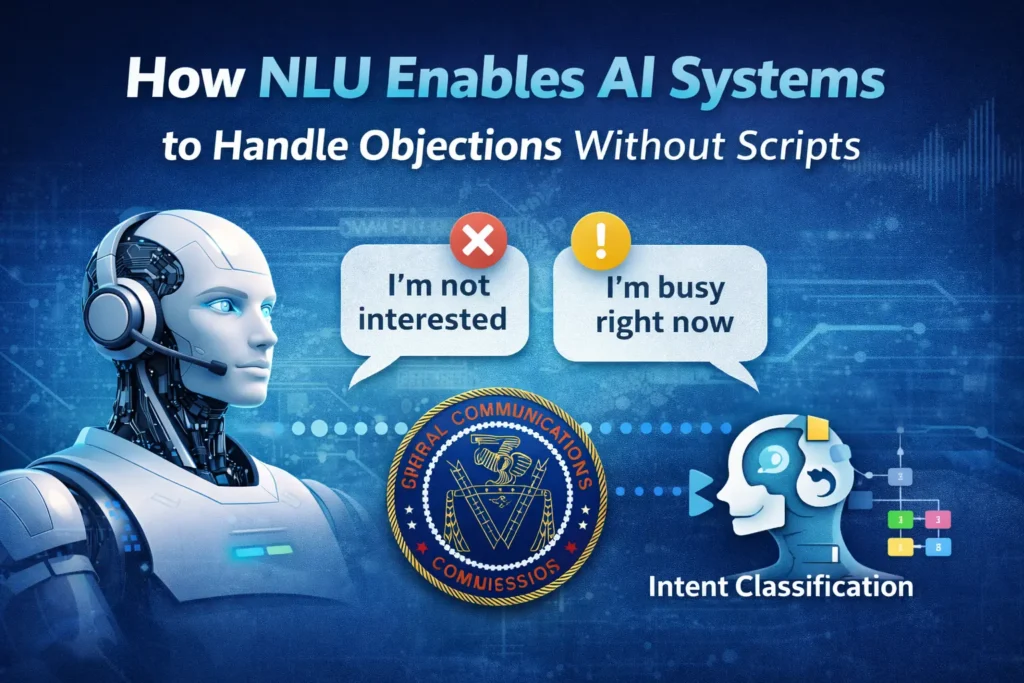
Modern AI agents use Full-Duplex Natural Language Processing (NLP) to handle interruptions and context-aware objections in under 500 ms, which is the “Trust Threshold” for human-like conversation.